Monday, August 4, 2014

Lake Michigan Dive

With the short summers we have here in Wisconsin, everyone does their best to make the most of the season.  We at Manta Divers are no exception.

 On Saturday, 6 lucky Team Manta members joined me on two Lake Michigan dives off the catamaran, Mai Tai. I say the participants were lucky, but perhaps quick is a better descriptor.  This dive outing was booked within a week of being posted on our calendar. We left McKinley Marina in Milwaukee at 8am and headed out to the Prinz Willem and the Dredge, two of the lake’s most popular wrecks. The lake was flat as could be, so the 40 minute cruise to the site was particularly enjoyable. I enjoyed sitting on the bow watching the sun climb in the sky, letting the lake breeze blow my hair.

Though the water was exceptionally flat, exceptional underwater visibility was not a guarantee. However, when we got to “The Willie’s” mooring, it looked quite promising.  We all geared up and entered the water, bracing for those first trickles of frigid Lake Michigan to seep into our suits. (That is to say all of us but the drysuit divers!)   After checking that everyone was squared away, we signaled to start the descent. 

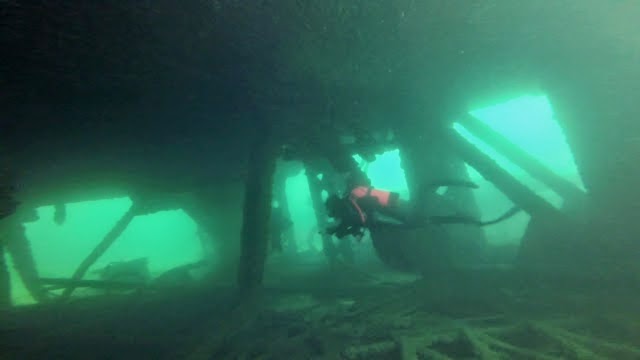
It is imperative in Lake Michigan that divers descend with at least an eye on the mooring line. The thing is that there may be a mild current and even if a diver thinks that he is descending straight down, he may not.  It is exceedingly easy to miss the wreck all together, and not be able to find it at depth.  Therefore, we made our descent along the mooring line and soon were at 70 ft. looking at the stern of the Prinz Willem.  We could see almost to midship from that vantage point, so we all knew we were in for a treat.  We toured around the 258ft ship, now encrusted in mussels and algea. With such great water clarity, divers were better able to get a sense of the majesty of this ill-fated vessel.   As the wetsuiters got cold, and others came to the end of their air, the group ascended and ended the dive.
Photo by Scott Durban

We sat around the charter boat discussing the dive and rehydrating while Captain Rick ferried us to our next site, the Dredge No. 6.  At the Dredge’s mooring, we could see the top of out of the “spuds” for this upside down wreck, portending another clear water dive.  Again we jumped in, checked that everyone was ready and started our descent.  The Dredge is one of my favorite dives, with its inverted position, all the spools and rope hanging underneath, and the huge dredge shovel. On past dives on the Dredge, I had to piece together in my mind what the whole thing looked like from small 10ft.snapshots, but on Saturday, we could almost see it in its entirety. So cool!


We will definitely make some dates to do this again next year, but believe me when I say to get your money in ASAP once the dates are announced, or you will be missing out again!


Sunday, July 27, 2014

Good Divers are Always Learning

Good divers are always learning.  This is what is printed on the front of every Dive Training magazine, and exactly what we did one our recent trip to Mermet Springs in southern Illinois.

Even if you are a very experienced diver, any change in equipment or environment presents a chance to expand your scuba knowledge and experience. Within the Mermet group, Jerry and Anthony had new BC’s, Sheryl was working on mastering her drysuit skills, and Tater was diving in a drysuit for the very first time.  In addition, Mermet Springs was new to all of us.

The first thing we did once we parked our trailer was get an orientation to the dive park with Mermet Springs’ owner, Glen Faith. This dive quarry is very well thought out. The covered pavilion that was reserved for us was equipped an overhead fan, electricity and two gear tables with bungies for securing our gear.  Each training platform is marked with a large white buoy, and each sunken attraction is marked with an orange buoy.  Each buoy has a notation on it indicating what is below it and at what depth.  In addition, under the water, all the attractions are connected with ropes that have tags indicating what the next thing is and how deep.  It is impossible to get lost! The main dock, which was just steps from our pavilion, was even handicapped accessible with a lift for getting in and out of the water. With that information, we felt ready to hit the water.

With all the new equipment, the first order of business was to do a weight check.  It is obvious that a new or different wetsuit or drysuit will require a weight check, but even a change in BC can effect the amount of weight required and its distribution.  After fine tuning our weights, we were ready to go.  We decided to spend a little time on a training platform to give everyone time to hover, check trim, and generally become familiar with the location of all their dumps, buttons and hoses.

After the underwater check, we took off for a tour.  Mermet is unique in many ways, but one really surprising thing is that they have music piped in underwater.  This makes it nice to swim around with something other than your breathing to listen to.  The underwater speakers also have a less frivolous purpose as well; they serve as a diver recall system when needed to reunite dive buddies. So, we swam along listening to classic rock, looking at all the fun stuff. Our divers with new equipment played with their buoyancy.

Tater commented that at times he felt like he did when he was a brand new diver. If you are used to being highly competent underwater, it is a bit humbling to suddenly return to that awkward “newbie” state.  However, there are definite rewards to be reaped by challenging oneself and learning something new. 


Yes, new divers long to get themselves to a state of true comfort and confidence underwater, but once that comfort level is achieved, if they really want to be good divers, they will find the next thing to challenge and educate them.

Sunday, July 20, 2014

Hey Blogsters!

Hey Blogsters!

I was snooping around on Scuba Board, an online forum for divers, and stumbled upon a quote that really struck a chord with me. It stated, ”When training a new diver, success is not them earning open water certification, success is seeing them dive next year.” I wholeheartedly agree! If you have been reading the blog, or were trained by Mike and me, you know we are constantly pushing local diving, dive travel and divers gearing themselves so they can dive when they want. We are not doing this to make money, but rather to truly ignite in our divers a passion for this sport and to see that enthusiasm reflected in the faces of our former students. 

I have had my share of students who signed up for class just to dive on a trip, or to keep their buddy or girlfriend company, or for some other reason other than their own passion. My job then is not just to inform them about diving, but ignite in them a passion for the sport. In the classroom, I try my best to get them excited about diving and dive travel.  I impress on them the importance of staying in “scuba shape,” and diving frequently.  For their open water certification dives, I go a step further. Rather than take them to a murky water hole that is closer and more convenient for us, we make an event that includes our students as well as certified divers out for experience and fun. These spots may be a little farther away, but because they are more of an underwater park, with interesting stuff sunk in them, (not to mention water that is clear enough to make viewing these things possible) they make a more enjoyable experience for the newest  divers.  By certifying the divers at one of our “events” the newcomer also sees how experience can be gained by diving with a group of people who are helpful and work as a team. If we’ve done our job well, we will make divers for life.

We always are happy when newly certified divers decide to come along on either our local or tropical dive trips and we love sharing the experience with them. Even if they are not diving with us, I still like to hear that they are diving somewhere with someone.  Nothing makes me happier than to hear dive adventure stories from former students. In fact, I am constantly on the lookout for guest bloggers, or for fresh photos for the shop’s FB page, and will happily publish your story.  True adventure stories are the best to whet the diving appetite of other divers!

I just certified two new divers today, and in a week, they are off to Jamaica for diving.  I can’t wait to hear how their dives were and I sincerely hope to see them dive with us a few more times this summer.  That’s how I’ll know if I did a good job.


 (P.S. A big sarcastic “Thanks a bunch”, to Tater for getting me on Scuba Board.  Now I’m really behind!!)   

Sunday, June 29, 2014

Stories from the Repair Bench

Picture #1
It’s always sad when divers bring me gear that can’t be fixed or repaired, not because it got to be too old but because of improper care.  It’s also expensive. Take the diver whose dive computer gave up the ghost prematurely.  It didn’t have to happen. After close examination it was obvious that the diver’s air integrated computer with quick release  had not been properly rinsed after diving. ( see picture 1) Note the salt build up on the threads, O-ring and the bayonet quick release. It was obvious that without proper rinsing the salt dried the O-ring allowing salt and moisture to get into the computer.  End of computer.  You should always thoroughly rinse your gear at the end of every dive day. If you have done repetitive dive over many days it’s always a good idea to soak your gear overnight after washing it with recommended shampoos. This is true in fresh or salt water. While the aforementioned computer was the victim of salt water , fresh water can be just as harmful. Improperly rinsing in fresh water grows harmful bacteria. Check out picture #2. This diver regularly “Dipped” his regulator after diving to rinse it. That green stuff in and around the mouthpiece is mold. I didn’t take pictures of the interior but they were just as bad. It could have been avoided by flushing the inside of the regulator with clean water.
Picture #2

There are a lot of divers out there doing their best to keep repair technicians busy.  I was recently talking to another technician from the Chicago area and we were both sharing equipment horror stories. At one point he got out a box of little baggies containing things that they had found in regulators over the years. There was sand, gravel, hair, shells and plant to name a few. The best was the regulator that a diver brought with the complaint that it that tasted funny. No matter what tank he put it on the air had a horrible taste. My friend held up the baggie t contained the cause of the bad taste. It was a frog the got up into the regulator and after passing on dried to the inside of the regulator box. GROSS!  Remember, take care of your gear and above all, rinse all frogs out of it!


MIKE

Sunday, June 15, 2014

Fighting the Invaders

Well, never let it be said that Manta Divers does not come up with some really different activities for divers. If you follow the blog at all, you will recall that yesterday was our day for picking weeds underwater.  We did and it was a wonderful day.

We left the shop at 7AM and headed out to Troy, WI and the Nature Conservancy’s area on Lake Lulu.  While we were setting up our gear, Mike and Southeastern Wisconsin Land Steward, Jerry Ziegler, set the dive flags to mark off the area where we would be working to carefully remove invasive Eurasian Water Milfoil (EWM). 

With the dive flags set and our scuba kits assembled, we boarded the pontoon boat and headed out.  Surface support included Jerry, Mike, Kathryn and Jerry’s intern, Elizabeth.  Their job was to keep an eye on the divers, look for any stray EWM, exchange full collection bags for empty ones, and make sure that boaters obeyed the law and stayed 100ft from our dive flags.
Photo by Kathryn Elliott
Meanwhile, underwater, Sheryl, Chris, Brandon, Ken, Tater and I were diving in teams with one person carrying a mesh collection bag, and the other diver picking milfoil.  We were to find the offending plants and carefully pull them out, trying to get the roots as well as the rest of the plant. When we had our mesh bag full, we called for Elizabeth and she paddled out in the canoe to take our full bag and give us a fresh one to fill. 
At first, it was slow going, with only occasional small plants being found. I thought to myself, ”Wow, they really are winning this battle!” I was wrong, though, because as we continued to sweep the lake bottom, we were coming across large patches of the plant.  When we found the patches, both divers would pick, roll the long branches up in a bundle and place it in the bag.  You can guess what happened as soon as we started to pull up the plants.  Good thing for us, we would pick as long as we could, then move to another, clearer spot, pick there and then return to the previous spot.  Usually, the sediment cleared up enough that once again, we could see more plants to pick and our buddy.

Meeting the other dive teams at the surface, we would excitedly state that we “found the mother lode” and show off our bags.  We all enjoyed finding the big patches and clearing out so much milfoil. Jerry was really impressed with the amount of weeds we removed, and was so excited to have volunteers with our skills.  We were able to remove so much more than the snorkelers he has had help in the past because we could stay down for 30-40 minutes at a crack.
Photo by Kathryn Elliott
We dove for a couple of hours then broke for lunch, Mike cooking brats and hot dogs, and the rest of us sharing fruit, chips and other snacks.  Fortified and rested, we then swapped our tanks for fresh ones and hit the water again. 

It was a great day, fun and productive.  The only negative thing was a run in with some boaters who did not know that they were to stay 100ft from our flags and who, when informed of the law, expressed great displeasure that we had the audacity to take their spot in the lake.  The irony, of course is that we would not be doing this clean up if it weren’t for then I the first place.  They bring their boats through the river channel into Lake Lulu from another lake that has a EWM problem so severe that they have to use chemicals to control it. The EWM gets wound around their props and when they reverse them in Lake Lulu, the plants are deposited in the water where they float to the bottom, root themselves and start a new patch.
Photo by Kathryn Elliott

There are self-absorbed idiots everywhere, but fortunately, there are more people who are on board with trying to stem the spread of these invaders, who participate in these clean-ups and have fun doing it! 

Sunday, June 8, 2014

Neal Skrenes: Six things to know about Dive & Travel Insurance

Neal Skrenes
After a recent event that caused the cancellation of a dive trip three years in the planning, Mike and Lisa asked me to write about my experience with dive and travel insurance. So here are six things I think you should know about dive and travel insurance.

1. Be aware that Dive Medical Insurance and Travel Insurance are not the same thing, and that many Health Insurance Policies may not cover diving-related injuries or expenses.

I am a firm believer in Diving Medical Insurance and have been a member of DAN¹s Master/Premium diver policy since I first became aware of them in 1988. Other divers belong to other programs; having coverage is more important than which program you choose.

Something that not even all DAN members know, or understand, is that basic DAN insurance IS NOT TRAVEL INSURANCE, per se.

While it¹s true that DAN membership also includes a form of travel interruption and cancellation insurance, in order for DAN¹s medical evacuation policy to take effect, you must be ill enough to require evacuation to make a claim. DAN trip cancellation coverage only covers the DIVING-RELATED portion of your trip.

For example, if you booked a flight/room/diving trip to Bonaire and come down with a cold or ear infection, only your dive trips on the boat would be covered by DAN . . . because, according to DAN, you can still sit on the beach with a cold.

2. All dive accident policies require care to be first prescribed by a medical professional, documented in an itemized bill, reported to the insurer in a timely manner and other important details. You¹ll need to follow your policy rules to ensure coverage, not always an easy task in remote areas.  Sick as I was, I knew I¹d need proof that I had seen a doctor or visited an emergency room, so I asked for and obtained copies of the doctor¹s notes and the bill for services and medications. I also planned to see my own doctor as soon as I arrived home.

I think the main thing that confuses some divers about DAN is that the trip cancellation/interruption insurance included with DAN Preferred is that it applies only to diving-related cancellations:

"This benefit pays for the losses described below that an Insured Person incurs for a trip canceled up to the time and date of departure for a Sickness or Injury that would substantially impair his or her ability to dive. "

But it's not general-purpose travel insurance; it doesn't do anything for you if a hurricane wipes out your trip, someone dies, there are travel delays, lost baggage, etc.

3. As I began traveling to exotic destinations, I realized I needed coverage over my trip costs. Fortunately, DAN also realized this and offers "travel insurance² packages through its website.

Note that cancellation insurance must often be purchased and paid for within a specified number of days from the date that the trip¹s first deposit is due to be paid.

4. You aren't likely to need trip cancellation insurance if you're just getting into the car and driving 50 miles to the beach (or quarry). However, if you¹re planning a major dive trip that requires paying out a good deal of money and flight time, it¹s something to consider and I hope my advice is helpful.

5. What Good Travel Insurance Covers:
Cancellation - You become ill and need to cancel your trip
Missed Departure - A road traffic accident or some other delay causes you to miss your flight
Vacation Abandonment - Airport strikes cause you to abandon your trip altogether. (Cancellation is the one of the more common reasons people claim on their travel insurance policy); In my opinion, it's bad enough not being able to go on your trip, without the added blow of losing the money that you've shelled out, too.
Medical Expenses - You need to go to hospital, this can be very expensive should you need surgery. Medical expenses can be incredibly high in foreign countries; this is perhaps the most important reason for buying travel insurance, and consequently is the most claimed against. Do no underestimate how expensive medical bills can be!
Baggage - Your bags get lost or delayed in transit and you need to purchase new clothes to wear
Curtailment - There's an emergency at home and you need to go home, cutting your trip short

6. Points to Consider When Buying Coverage:
A common mistake is leaving travel insurance until the last
Minute. The best time to purchase your policy is as soon as you have booked and paid for your holiday. By doing so, you¹re saving money should you need to cancel your trip or if a strike is announced that disrupts your travel plans and you need to make alternative arrangements.

Lost Equipment Coverage generally covers only diving equipment that is worn on the diver's person that is "cut loose" and is lost or damaged as a result of a Covered Diving Accident.  For full coverage of lost diving equipment you should have separate sports gear coverage added to your home or renters insurance policy.


In my case I was glad to have purchased both DAN Medical Insurance and DAN Travel Insurance - though I missed out on some long anticipated diving I received adequate compensation so that I did not lose most of my non-refundable trip expenses.

Sunday, May 25, 2014

I got my GOES card

It’s not a card issued by AARP that confirms my ability to GO. On recent trips out of the country, Lisa and I noticed the Global Entry lines.  There were few people in them and the ones that went into those lines moved through them in quick fashion.  A friend who travels for his job told us we had to get the GOES card and it would truly be worth the $100 you pay for the application. After nearly missing a connection at the Miami airport due to excessive slow moving lines, we decided to do it.

GOES is the acronym for GLOBAL ONLINE ENROLLMENT SYSTEM.  Global Entry is a U.S. Customs and Border Protection program that allows expedited clearance for pre-approved, low risk travelers upon arrival in the United States. There is no minimum number of trips necessary to qualify for the program. Participants may enter the United States by using automated kiosks located at selected airports. To get a GOES card, you have to agree to divulge a lot of personal information.  Face it: this information is already available to the government, so as someone with no terrorist links or desire to conduct international illegal business, I don’t have a problem laying it out for them.  You go to the Global entry website,  (https://goes-app.cbp.dhs.gov/main/goes) and register.  After your application is submitted and your check clears, you will get a letter directing you to make an appointment for an interview. At the interview, you will be photo graphed and your fingerprints are recorded.  The officer will question you about where you travel, what your occupation is, and if you have any outstanding criminal charges.  Assuming you answer to the officer’s satisfaction and everything checks out, you will be mailed an ID card in a protective sleeve to carry with you when you travel. (The protective sleeve shields the RFID chip in the card so your information can’t be accessed.)

Once you receive and activate the card, you can add that ID number to airline reservations to mark your travel documents to indicate that you are a trusted traveler.  This really smooth’s the road through the airport! Once check in luggage is dropped off, GOES participants proceed to the shorter Global Entry line to TSA check in.  In that line, GOES ID holders do not have to take off their belts and shoes, and the search is less invasive.  A word to the wise, though, if, like me, you have artificially parts that set off the metal detector; tell the office right away.  They will then direct you to the front of the line for the millimeter scanner.  If you say nothing and set off the metal detector, they have no choice but to perform the usual pat down.
 
At major international airports, they now have kiosks for reading the traveler’s passport.  GOES participants have a special expedited line for this as well.  Once your passport is scanned, it will print out a “receipt” that shows your photo on it.  If there is an “X” over your photo, then you will have to talk to the immigration officer.  For a non-GOES traveler, this is another line to wait in, but for the GOES traveler, you will be put at the head of the line again and bypass all the waiting.  This is a really good thing if you are someone who has difficulty standing for a length of time, as this pass cuts through all that and keeps you moving along.
On our recent trip to Utila Lisa  and I both traveled with our new GOES cards and it relieved much travel stress by allowing us to navigate the customs lines so quickly.


On our way back into the country and to our connecting flight, we were also among the first people to get to the baggage claim and back though TSA check in.  (If only they had GOES for luggage!) Getting our GOES card cost $100 but was a small investment towards  more enjoyable travel.