Showing posts with label Guest Blog. Show all posts

Sunday, June 8, 2014

Neal Skrenes: Six things to know about Dive & Travel Insurance

Neal Skrenes
After a recent event that caused the cancellation of a dive trip three years in the planning, Mike and Lisa asked me to write about my experience with dive and travel insurance. So here are six things I think you should know about dive and travel insurance.

1. Be aware that Dive Medical Insurance and Travel Insurance are not the same thing, and that many Health Insurance Policies may not cover diving-related injuries or expenses.

I am a firm believer in Diving Medical Insurance and have been a member of DAN¹s Master/Premium diver policy since I first became aware of them in 1988. Other divers belong to other programs; having coverage is more important than which program you choose.

Something that not even all DAN members know, or understand, is that basic DAN insurance IS NOT TRAVEL INSURANCE, per se.

While it¹s true that DAN membership also includes a form of travel interruption and cancellation insurance, in order for DAN¹s medical evacuation policy to take effect, you must be ill enough to require evacuation to make a claim. DAN trip cancellation coverage only covers the DIVING-RELATED portion of your trip.

For example, if you booked a flight/room/diving trip to Bonaire and come down with a cold or ear infection, only your dive trips on the boat would be covered by DAN . . . because, according to DAN, you can still sit on the beach with a cold.

2. All dive accident policies require care to be first prescribed by a medical professional, documented in an itemized bill, reported to the insurer in a timely manner and other important details. You¹ll need to follow your policy rules to ensure coverage, not always an easy task in remote areas.  Sick as I was, I knew I¹d need proof that I had seen a doctor or visited an emergency room, so I asked for and obtained copies of the doctor¹s notes and the bill for services and medications. I also planned to see my own doctor as soon as I arrived home.

I think the main thing that confuses some divers about DAN is that the trip cancellation/interruption insurance included with DAN Preferred is that it applies only to diving-related cancellations:

"This benefit pays for the losses described below that an Insured Person incurs for a trip canceled up to the time and date of departure for a Sickness or Injury that would substantially impair his or her ability to dive. "

But it's not general-purpose travel insurance; it doesn't do anything for you if a hurricane wipes out your trip, someone dies, there are travel delays, lost baggage, etc.

3. As I began traveling to exotic destinations, I realized I needed coverage over my trip costs. Fortunately, DAN also realized this and offers "travel insurance² packages through its website.

Note that cancellation insurance must often be purchased and paid for within a specified number of days from the date that the trip¹s first deposit is due to be paid.

4. You aren't likely to need trip cancellation insurance if you're just getting into the car and driving 50 miles to the beach (or quarry). However, if you¹re planning a major dive trip that requires paying out a good deal of money and flight time, it¹s something to consider and I hope my advice is helpful.

5. What Good Travel Insurance Covers:
Cancellation - You become ill and need to cancel your trip
Missed Departure - A road traffic accident or some other delay causes you to miss your flight
Vacation Abandonment - Airport strikes cause you to abandon your trip altogether. (Cancellation is the one of the more common reasons people claim on their travel insurance policy); In my opinion, it's bad enough not being able to go on your trip, without the added blow of losing the money that you've shelled out, too.
Medical Expenses - You need to go to hospital, this can be very expensive should you need surgery. Medical expenses can be incredibly high in foreign countries; this is perhaps the most important reason for buying travel insurance, and consequently is the most claimed against. Do no underestimate how expensive medical bills can be!
Baggage - Your bags get lost or delayed in transit and you need to purchase new clothes to wear
Curtailment - There's an emergency at home and you need to go home, cutting your trip short

6. Points to Consider When Buying Coverage:
A common mistake is leaving travel insurance until the last
Minute. The best time to purchase your policy is as soon as you have booked and paid for your holiday. By doing so, you¹re saving money should you need to cancel your trip or if a strike is announced that disrupts your travel plans and you need to make alternative arrangements.

Lost Equipment Coverage generally covers only diving equipment that is worn on the diver's person that is "cut loose" and is lost or damaged as a result of a Covered Diving Accident.  For full coverage of lost diving equipment you should have separate sports gear coverage added to your home or renters insurance policy.


In my case I was glad to have purchased both DAN Medical Insurance and DAN Travel Insurance - though I missed out on some long anticipated diving I received adequate compensation so that I did not lose most of my non-refundable trip expenses.

Sunday, May 18, 2014

Tales of Tater: Dive Software Test


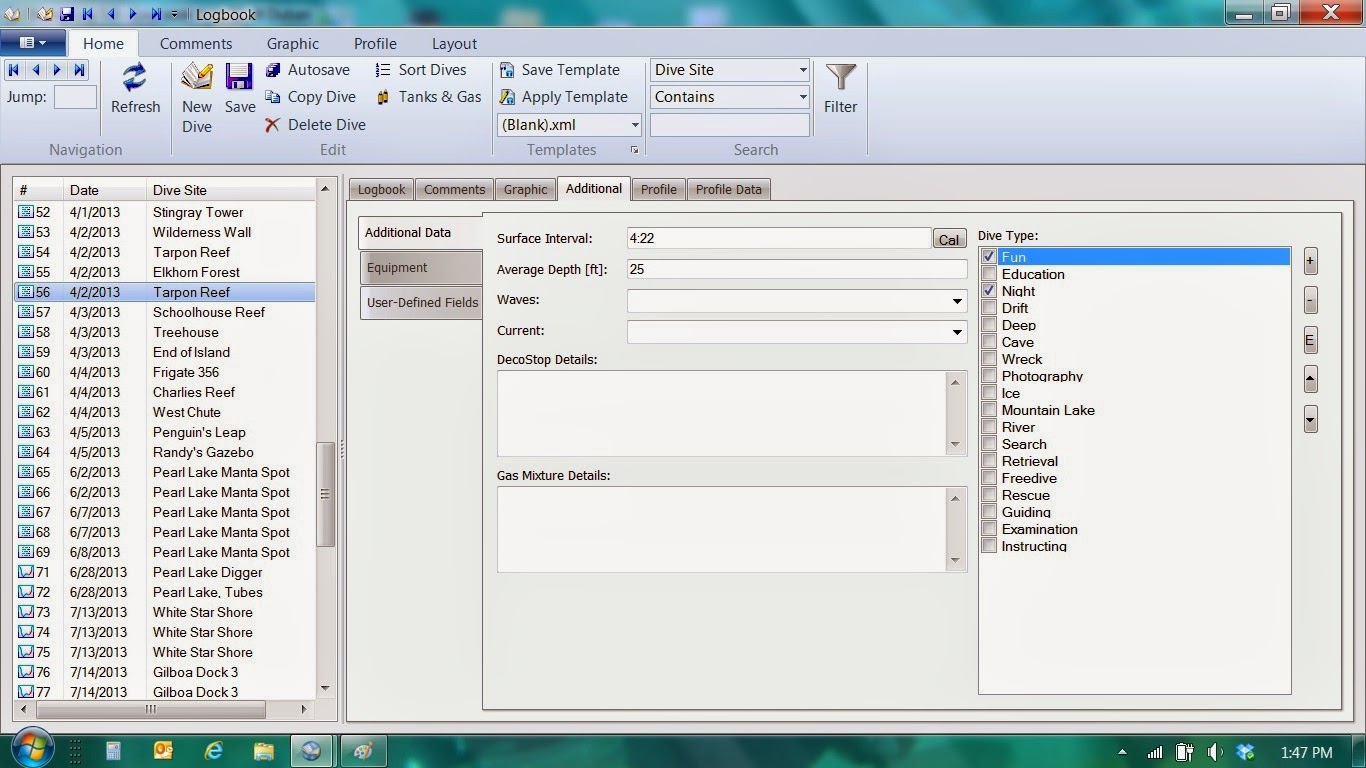
One of the first things we learn as divers is to fill out our log books.  It's important to keep track of the number and details of your dives especially as you progress with more advanced training.  I log each one of my dives and include notes, sites dive buddies etc.  The technical portions of the dives are copied off of our dive computers.  Items such as depth, time, dive time, surface interval etc.

With modern dive computers comes the ability to communicate from computer to computer.   Now we can download the information stored in the computer to a PC.  What`s the point of that?   Well actually there are several. I dislike the process using my thumbs to navigate through the menu on the dive computer.  I would rather let the computers do that.  I also dislike writing down all the technical details mentioned earlier.  It isn't terrible but I prefer to do it all at once when I feel like it rather than right after a dive.  I also like the ability to tie pictures that I've taken on a dive to the specific log off that dive.  It makes them both more interesting together.  Finally the biggest reason to do that is that I am a dive geek, in mathematical terms; Diver + Geek = Dive Geek = Tater. 

After spending some time on the Google machine to investigate, I found one of the packages that sounded the best was called Dive Log 5.0., the problem with it was the cost; roughly $50.  As any tightfisted engineer would know, you just don't plunk down some cash based on the marketing of a product.  But a good manufacturer will understand that and let you try it.  I downloaded the free demo and started to play with it.  I was not completely sold (Manta and/or my wife will enthusiastically confirm that I don't buy anything quickly)

$50 is a lot more money than my log book refills!! On the other hand since I don't have any quarry fees, motel stays or dive refreshments to buy until summer, $50 for a onetime fee doesn't see too terrible.  In a weak moment I pulled the trigger and ordered it.

One of the features I like the best about the software is the ability to connect my dive computer to the laptop and just download the most recent dives. I simply connect the cable from my Suunto Vyper to the PC using the provided USB interface cable, go to the download menu in Dive log 5.0 and press the button.  Dives are automatically added to the end of the existing dive log.  You can then edit anything about the log entry including the dive number.  This is a real must for several reasons.  First if you are like me you may want to enter a bunch of dives from before you got the dive computer.  Second, I don't consider every dive that my computer logs to be a separate dive.  Sometimes we just surface to adjust gear, get our bearings, help a student etc..  I often combine dives after they are downloaded.   I can take what the computer calls 3 separate dives of 3 minutes, 10 minutes and 15 minutes respectively and just modify the log into 1 dive of 28 minutes.  If I take my dive computer into a Manta Pool Session it gets logged as a dive and I can just delete that one. 


The details that are downloaded to a log will vary according you your dive computer.  A dive computer such as the Atomic Cobalt provides a lot more information that does my Suunto Vyper, but I have the ability to add to or overwrite any information that is downloaded.

Once you have the dive information logged in correctly you can really start to use the software as you like.  I always like to add a few notes to each log just as you would in a logbook version such as what fish you saw, who your dive buddy was, visibility etc.  There are a lot of built in information in the software that you can use such as dive buddies (which it keeps track of so you can just pick names or groups on subsequent dives),  Tank Pressure, etc.  You would sort of expect that in an electronic log and it is all there.  In addition, there are categories of dives that you can use such as Night Dive, Deep Dive, Teaching, Leading, etc.   These items are also tracked for other uses. But wait, there's more!!

One fun little tool is that you can use maps to track the location of your dives.  Not just say 'Pearl Lake' but you can attach an actual map location to it as you might with Google maps. This information is also stored and can be selected on future dives.

Another fun and/or useful things that the package does is give you the ability to get statistics from the stored dive logs such as how many of a particular type of dive, location of a dive, how many dives with a particular dive buddy,  how much total time under water, number of dives in a location etc.   Nothing like a nice graph to get a geek's heart racing :)

Probably one of my favorite features is the ability to add pictures to the dive log.   I take a fair number of GoPro pictures and while I sometimes make YouTube type videos out of them, I almost as often grab snapshots out of the video.  There is a drawback here that the software does not support video.  I spoke with the developer and he is hoping to add that to future versions but for now it only supports pictures.  You can attach pictures to each dive so that 2 years from now flipping through your log, you can tie the photo to the specific dive and dive log information.  I really enjoy this because I can now take the pictures from say Cayman Brac and directly tie them not only to Cayman Brac, but the specific dive, dive Buddy depth, dive site name etc.   I find that connecting the picture with the dive specifics makes the picture more interesting and also the dive log entry more interesting by tying the memory all together.  (This is especially helpful as I get old, senile and get in more dives)


 But wait!  There's more!!  Aside from the advantages of the software, they have a working relationship with other software vendors for both Android and Mac.   Who cares?  Well there is a big advantage there in my book. 

Many of us have done dive trips to remote tropical locations.  One of the big problems with flying with dive gear is packing. Weight and space for a dive trip are at a premium and can be very expensive if you go over the restriction.   Well one of the things I carry with me on trips is my laptop.  I have an older 15" Dell that I take mostly to use with my GoPro so I can download the video.  Mine weighs a few pounds and is about 2 inches thick.   What if I didn't have to take it?  What if I could use a 7" tablet and download save all of my video files to the tablet or a memory stick?  Well I can.  And now I also have the ability to download my dive computer to my tablet.   Dive Log 5.0 works with an Android application called Divemate USB.   I can load all of my electronic dive logs (minus pictures) onto a cloud application called Dropbox and use it to transfer all of my log information onto my Android tablet


as well as my phone using Divemate.  


It is a separate application but holds all the same information except the pictures (pictures can be added to but are not automatic and I wouldn't waste the memory space).  It is two way sharing in that I can also use Divemate to download new dives from my Vyper directly to my tablet and Divemate will allow me to transfer the information back to my PC and the Dive Log software through the Dropbox.  Oh man Jimmy Ray you gotta be lovin' this!!!

I love the fact that I can use both packages for the same information and each has some advantages.  For example Divemate has a built in feature of combining dives, which I previously mentioned I do manually in Dive Log.  But I much prefer the Dive Log software because of the statistics and generally more comfortable viewing on the larger screen. 

I don't claim this is for everyone and there are a couple of drawbacks.  If you want to log previous dives to catch up to your current dive (which you do not HAVE to do) you either need really good information or it can distort some of the statistics that it produces.  For example if you don't have a detailed record of your tank pressure delta on a given dive or dives, it will be included in your SAC calculations and can throw that off.  

If I lived somewhere I could dive 150-200 dives a year, I might skip all the features and just use it because it was easier but since I generally have several months of the year where all I can do is dream about diving and re-live past dives, I really do like the product and messing around to find all kinds of things such as number of dives at a given depth, temperature, number of dives by month, number of dives with particular dive buddies, training dives, night dives etc. as well as being able to put the right pictures with the right dives. And oh boy, who doesn't like a good graph??    But wait, there's more!!


Call Manta Divers now and get a free air fill with any gear purchase over $200 with one easy payment.  Yes you heard right, that's a $10 savings if you call now.  Operators are standing by.

Photo Credit: All Photos in this blog post are the work of Scott Durban

Sunday, July 14, 2013

GUEST BLOG: Matt's Open Water Adventure

This week, we have a guest Blogger, Matt Wozniak.  Matt recently earned his open water certification and is now looking forward to some dives on the Great Barrier Reef.  I asked him to share his experience in Manta Divers’ open water course.
Matt, the diver!
What is it like going through the PADI Open Water Diver course and becoming a certified diver?

It was an adventure and a half. From reading the instruction manual to my final open water dive, I was enthralled.

After receiving my manual from the dive shop and a short drive home, I instantly started to read, take notes, and answer all the knowledge reviews in the manual. The reading which is a bit long is probably the most grueling art of the class because the diving isn’t actually tangible yet, but it has to be done. The knowledge you learn from the reading is indispensable and really helped me through the classroom as well as the water. Next came the classroom sessions where the other students and I reviewed what we read and took several quizzes and a final over the entire manual. All this classroom stuff sounded a bit frightening and overwhelming to me at first, but once in the dive shop, those feelings drifted away. The quizzes were not overly difficult, and during the class, I got to breathe through a regulator for the first time and put together a whole scuba unit by myself which allowed me to see the finish line, when I would be a certified diver.

The fun part. The DIVES. My first breath underwater is something I just cannot explain because I did something that the human body wasn’t meant to do, but, yet, there I was in a pool underwater and not drowning. I broke down a limit and discovered a whole new world. 

The confined dives in the pool are almost the same as a class, but it’s just underwater. We went over basic skills in this controlled environment to make sure we understood what we read and went over in class. One student would complete the skill then the next student would perform the same skill, and this went on until every student completed each skill. These dives are a rehearsal for the open water dives.
To Pearl Lake we go!
The open water dives are truly the highlight. My dives were in the pond next to the RecPlex and Pearl Lake. In these dives, you also have to complete similar skills to the one completed in the pool, but it is just so different. There’s sand, seaweed, and fish around you when you’re completing the skills. These dives are real so there’s a sense of danger almost, and I became really excited which elevated my breathing so much that I finished 3 tanks in 3 dives. However, while I was at depth, it was breath-taking. I swam past a couple of boats, an ice cream truck, and a submarine! I got into a staring contest with a fish; the fish won, but I was right in its face!

It’s just a totally different world underwater. And being able to stay down there for an extended period of time with scuba is something everyone has to try once. It is absolutely amazing and absolutely worth it.

Thanks Lisa and Mike for teaching me how to dive safely and how to really experience the underwater world.

Matt Wozniak


P.S. Always go to the bathroom before suiting up!

Sunday, June 16, 2013

GUEST BLOG: Neal Skrenes gives the Brac Report

This week's blog is brought to you by Neal Skrenes!
Neal Skrenes: Gentleman, Scholar, and Diver Extraordinaire! 

March 30th 2013 eleven of us began our journey from Kenosha at the ungodly hour of 2:30 a.m. with a limo ride to Chicago O’Hare airport. Check-in was at 4 a.m.; the usual lines, waiting, document- and baggage-checking that dive travelers have come to expect were all part of the morning. Our route was Chicago to Atlanta, where we met up with four more of our group, then on to Grand Cayman, where the final two members of Team Manta flew with us on a Twin engine DeHaviland DHC-6 "Otter" - our ride to Cayman Brac.

Cayman Brac is the smallest of the three islands that make up The Caymans; Grand Cayman & Little Cayman are the other two. It is about 12 miles long, with an average width of one mile.

Its terrain is the most prominent of the three Cayman Islands due to "The Bluff", a large central limestone outcrop rising steadily along the length of the island up to 140' above sea level at the eastern end. The island is named after this prominent feature; "brac" is a Gaelic name for a bluff.

From the new airport we were transferred to Cayman Brac Reef Resort - our home way from home for the next week - and checked in. The rooms were very modern, having been renovated in 2009 courtesy of Hurricane Paloma. The island was hard hit in November of '08 when 90% of homes lost their roofs, and the original Cayman Brac Resort was demolished. It was the last existing hotel on the island and as a result the island was closed to tourism for almost two years.

After dropping off dive bags and blue jeans in our rooms, we proceeded to the dive shop to show dive certification cards, fill out forms, put some Nitrox in tanks for Sunday's diving and learn more about the diving operation before dinner.

The resort is very well laid out for diving visitors. The rooms are of a shotgun design with a porch that faces the pool area; many also have a view of the Ocean. Next to the pool is the bar/game area. It's also where they host a weekly outdoor movie, crab races, a trivia contest and barbecue.
 

You can also tour a Bat Cave.  You know, you think that it would be better hidden....
Dinner was in a dining hall and very upscale compared to some all-inclusive resorts that are more like Dive Camp. In addition to a regular chef who organized a delicious breakfast buffet starting at 7 a.m., cold cereal, fruit, breads, meats, hot eggs on buffet for breakfast, or, if you had time you could have omelet to order. There was plenty of juice, coffee & tea and cold water on the tables. Lunch and Dinner worked the same way - a buffet that varied every day with a special choice of meat sliced to order. Mario, their excellent pastry chef, was busy so there were always three different choices for dessert. Mario was such a hit with Team Manta that we organized an impromptu serenade extolling his virtues the last night we were there. You can check it out here.

The dive shop personnel collected our gear from outside our rooms on Sunday morning and brought it to our assigned boat for the week, Big Sister, where BJ & Brett switched off as captain & dive master; these two young men were outstanding hard workers. They provided what they called valet diving: You put on your skins, mask and fins at the back of the boat, they brought your gear and placed it on your back, so all you had to do was fall into the water. I had knee surgery a few years ago and choppy seas are always my concern when getting back on a boat. Bret and BJ were happy to hoist my gear out of the water so all I had to do was climb up the ladder. The most strenuous thing those of us using Nitrox had to do all week was to ensure that each day we had three tanks for which we had checked and marked the mixes.

A well run and well organized Big Sister!
The dive briefings were comprehensive and BJ or Brett would also stop under water and point out small to macroscopic marine life (easy to miss if you're not trained or experienced in finding it). We did three dives a day, except Friday when we did not do an afternoon dive, two before lunch and one after for a total of 18 dives. The water averaged 80F, so 3mm or 5mm suits (for the more cold blooded) were adequate. One morning dive also was a preparation for a night dive on Tarpon Reef so that it would be familiar territory to explore in the dark. Thursday morning we dove the M/V Captain Keith Tibbetts, also known as the former Cuban Navy Koni II Class frigate designated 356. The video is here.


There were lots of land-based activities in the evenings. A ping-pong table was available. One night an excellent fish identification movie shot at the resort by the local videographer previewed underwater sights for which to look. On different days there was a land crab race, trivia contest, bingo. Internet and television were also available. I used the former to keep in touch with my wife, sending her daily trip reports and photographs for her web page. If you'd like to see some of the photos and critters I saw
visit the website.


On Friday some of the team traveled to Little Cayman and did two dives there Penguins Leap & Randy's Gazebo - I elected to skip that trip to stay back wash and dry my gear and relax a bit. After lunch some of us did an island tour visiting some of the historic and scenic parts of the island. We were
hoping to see some wild parrots, but they all must have been hiding that day. Our last night at the resort there was an outdoor barbecue (a weekly occurrence).

Saturday morning we had to rise quite early (4 a.m.) in order to get to the airport in time for the first leg of our trip back home. This was uneventful trip back to Chicago and then home.

It was another trip with a wonderful group of divers - proving yet again Manta Divers are "More fun than regular people". Cayman Brac is a destination to which I would return.

Sunday, June 9, 2013

The Tale of Tater: Relearning Old Tricks


Hello Team Manta!!  I hope everyone has survived the seemingly never ending winter and is ready to get out and do some diving, I know I am ready!  (Ok no surprise there).   Pearl Lake and Haigh Quarry are open for business!! Probably freaking cold, but open.
Now back to my DM quest. Real life got in the way of our Divemaster training and we had a tough time getting a schedule fixed up for all of us, so with Lisa’s guidance I jumped into working on the DM required 24 skills.  Now as divers you have all done the 24 skills at some point.  Most of the skills we have done at least twice, once in the pool and once in open water.  Some of the skills we do on a regular basis in the course of diving.  Some of the skills may not have been done since certification.  As for me, my dive buddy and I have committed to practicing those skills during the course of each dive season, but in all honesty we usually have more things we want to do on dives, than dives to do them.  Thus the good intentions are not all fulfilled. If only we lived in a year round dive location like Cayman Brac..(Insert longing sigh and Jimmy Buffet music here).
Do you like pina coladas?

When it comes to the 24 dive skills, for certified divers there is nothing particularly difficult about performing them.  Some of the skills such as removing and replacing all gear under water have a few challenges that we may not be used to, but with a little effort they get accomplished.  For new divers, that is not usually the case.  They are in an environment they are not used to with equipment they haven’t used before; doing tasks they have never done before.  That’s where the Scuba Instructor and Divemaster need to be able to slowly, accurately and with added emphasis demonstrate the dive skills.  It is very different to be able to perform the skill vs. be able to carefully demonstrate the skill.  To learn to demonstrate the skills is almost like learning them all over again.  
Take remove and replace the regulator as an example.  We have all done it many times, often for fun or to ham it up for a picture.  When demonstrating for students there is the added emphasis of pointing out that the regulator should point down, the natural instinct is to point the mouthpiece away from you.  Students also frequently need to be reminded to exhale a stream of bubbles any time the regulator is out of their mouth so as to not hold our breath.  Even something that may seem obvious to a certified diver, such as making sure to first put the regulator back in your mouth and then purge the regulator before breathing may be something a new student doesn’t realize in this strange new environment.  I had to learn to stop and dissect every movement for clarity.  I’ve used this skill as an example but the idea applies for each of the 24 dive skills.
Also, it is important to know which way the bubbles are going!
The follow up to re-learning all of those skills is to carefully watch students execute the skills.   Demonstrating is only half of the trick.  The other half is to study the student execution of the skill so as to be able to help students with their difficulty, if they have one.  Lisa having done this many times had some really valuable tips to share on what students may do incorrectly.  For example they sometimes do the regulator recovery sweep by dipping their shoulder on the same side they see the demonstration like a mirror image, which of course is the side away from their regulator.  Another aspect of helping correct a skill is the underwater communication so as to be able to help them with emphasis on what they may have forgotten and to try again to properly execute the skill. Finally, the good part is to let them know that they have in fact done it correctly.

I won’t bother going through all of the skills, much too boring, and you get the idea.  From my perspective as a DMC, I am a student studying how to help students.  I do find it gratifying when I can help someone with a skill.  I want them all to have a great experience diving and hopefully come and join Team Manta on some dives.
Clearly these skills and teaching them are a requirement to become a DM but I also think it helps me as a diver to be even more confident and capable of doing those skills in the open water whenever they may be needed.  Not just the skills themselves, but the overall attitude/feeling to stop and think what is happening and then decide how to correct it.   
Having said all of this, I do feel like I can demonstrate the skills, I also feel like I can contribute to student learning.  I don’t feel like I am an expert at it by any means.  This goes back to taking my time.  I look forward to working with more students not only because it is rewarding but also because they will teach me how to be better at it.  When it comes to diving I need to practice, practice, and practice.  

I have an idea.  Let’s Go Diving!!

Sunday, May 12, 2013

The Tale of Tater: Why be a Dive Master?


I’m Baaack.  You can all get off the edge of your seats now, the wait is over.  OK so it’s not that exciting, but as far as I’m concerned anything SCUBA is of some interest.
This time I will discuss how I came to the decision to become a DMC.  There are many reasons, both for and against; I won’t be able to cover them all.  I know that I am not the only one who considered it with some skepticism.  I have a lot of fun diving, have a great dive buddy and we always seem to have fun just diving.  I don’t really have a great desire to schlepp tanks around and, don’t figure I can make a living as a DM.  For the life of me, I can’t see any logic in paying for the right to be slave labor on some evenings and weekends. (no offense to anyone who might be into that sort of thing!!)


I had a lot of fun in all of my classes but due to nature of the class it seemed like all of the students in my Rescue Diver class at least considered the possibility of doing Divemaster or Master Scuba Diver.  I had always wanted to take courses to become a better diver.  Deep, Navigation, Night, Search and Recovery, Rescue….Hmmm  Pretty much sums up the requirements for Master Scuba Diver.  I don’t think taking those courses makes one a “MASTER” Scuba diver, but it does give you a good bag of tools to use for diving.  I guess without really knowing it, I had made up my mind on becoming a ‘Master Scuba Diver’ pretty early on.  I’m already pretty close to being qualified and have one more class planned for spring/summer.
So what about Divemaster??  What turned around my skepticism?   Do I really want to teach/lead?  I waited 30 years to get back into diving; I really just want to enjoy it.  Being an engineer (Mike & Lisa LOVE engineer student divers!! Just ask…and ask….and ask) I just had to analyze the pros/cons.  

CONS:
  • Not the cheapest course you can take with all the books and videos etc.
  • Much more than a book test and a few dives.
  • More difficult requirements
  • Added Responsibility
  • Not really wanting to (help)teach
  • Time consuming with an already busy life
  • Summers are too short and my wife doesn’t dive
  • To what end?

This wasn’t an easy decision to make black and white.  As I said, I was pretty skeptical at first but a few factors not directly related to SCUBA were eating at me.  I had always wanted to go back to school to get my Masters Degree.  I tried several times to take courses but it seemed like every time I did, my job would force me to travel.  Now that I am older, I can’t justify the cost vs. payback on my going back to school.  I don’t want to have the same thing happen to SCUBA.  I didn’t want to find myself in 10 years looking back and wishing I had done it.   I had for years considered a part time job just to get out and socialize with people that weren’t all dorky engineers.  Maybe this was a way to do that.
Being a geeky engineer, all of those side thoughts had to be set aside so I could stick to relevant issues to make a decision.  I still had to finish weighing the pros/cons.  Fortunately humans have an amazing ability to twist statistics,  bend facts and rationalize items into what seems like logic, in order to conclude that which they hope to be true, regardless of reality. (definition of politician)

Pros:
  • A good investment in myself physically and mentally.
  • Much more than a book test and a few dives.
  • More challenging requirements
  • Additional Diving Responsibility
  • Learning better skills by preparing to demonstrate/(help) teach
  • Spending more time doing one of my favorite things
  • My wife doesn’t dive
  • I will have done it.


For me there was one other item that was really important to me.  I couldn’t stand the thought of not diving from October to the end of May.   As a DM(C) I get to at least get it the pool on a regular basis.   Every time I help in the pool, I get just a little practice in on my buoyancy, my demonstration skills, finning, and of course Schlepping.  In the summer I expect to get in a few extra dives helping with some students.  
Before I close here I have to fast forward just a tad.  It wouldn’t be fair to for me to not confess that while I did not look forward to it specifically, I have really enjoyed spending some time with some of the Open Water and Discover Scuba students.  Seeing the nerves and shivers turn into smiles and fun is pretty cool.  Not as cool as seeing a shark, but still pretty cool.

The meeting of the Underwater Basket Weavers Guild will now begin.
Ok.  From here on out we get into the DM training stuff.  I can’t wait for those end of chapter tests.  
Later,  Tater


Sunday, March 10, 2013

The Tale of Tater: A Dive History

They call me Tater!
Hello again Team Manta!

I’m back again to continue sharing my journey towards becoming a PADI Divemaster.   Previously I mentioned that I was certified a while ago.  Things were different back then in the SCUBA world.  Equipment was way different (perhaps I’ll discuss that some other time) and so were the certifications.  My course was 12+ weeks of 3 hour class/pool time and in addition to basic skills, included discussions of Boyles Law, fitness swims and CPR certification.  Despite the level of training and University credit, my certification was BASIC SCUBA DIVER which meant that I could rent gear and dive on my own, but only in inland lakes or in the ocean with supervision.  PADI now calls that level of training “Scuba Diver” certification, but I wanted the full Open water certification so the first order of business after my refresher course was to bring my certification up to modern standards and become an Open Water Diver.  That was the start of my new SCUBA training.    The checkout dives went fairly smoothly but I did learn I’m not fond of ‘performing skills’ as opposed to just relaxed diving.  I got that completed before my vacation to the Bahamas (Eleuthera) just in case there were any issues recognizing my 30 year old certification.  (Speaking of which, maybe sometime I’ll share why they call me Tater).


Diving is often compared to driving a car and while not a perfect analogy, I think it is a decent comparison in several ways.  Driving isn’t terribly difficult once you get the hang of it, BUT if you make a mistake at the wrong time, drive in conditions above your skill level, or think you are more capable than you really are, you can get yourself injured or killed.  You need experience to go along with the training.  If you want to drive a race car or a fire truck you need more training and more experience.  I view SCUBA the same way, getting certified only means you can dive, it doesn’t make you good at it.  If you want to dive deep, night dive or dive in conditions that aren’t ideal, you need more knowledge and experience.  When I went to the Bahamas’ I knew I loved the diving, but also that I had a lot to learn.  


The following dive season I signed up for AOW.  This course gets you a bit more exposure to different types of dives/skills. It is intended to give you exposure to skills and perhaps get you interested in particular types of diving but it also gives you a chance to learn more, get in some practice and still be under the supervision of an instructor while you expand your skills.  I liked the fact that you are pushing into new things, but only a little at a time.  My dive buddy and I did Navigation skills at Lake Andrea, Wreck and Deep dives at Pearl Lake and Peak Performance Buoyancy dives.  We chose those dives because we wanted to stick to dives we thought would not only interest us but also to make us better divers.  They were all fun too.  Mike and Lisa do a good job of combining real training with having fun.  OK, maybe the weeds in Lake Andrea weren’t a blast, but I had fun anyway.


One of the nicer aspects of the AOW dives is that they count as the first dive towards a specialty certification if you choose to pursue it.  As I described already, I had pretty much made up my mind which dives and specialties I wanted to pursue so it was sort of a ‘no brainer’ to combine the AOW with the specialties I was interested in.  That summer I pretty much did one specialty each month.   Some of the specialties overlapped a bit but I did what, at the time, felt like a lot of training.


Peak Performance Buoyancy:  In my opinion, this is one of the more important specialties for two reasons.  First, just about everything you do in diving is related to, improved by, or more enjoyable because of good buoyancy skills.  Air consumption, wreck diving, cave diving, reef diving, quarry diving and photography are all dramatically affected by buoyancy.  The second reason is that it is something that divers work on their entire careers.  Not many think their own buoyancy is perfect and many more think that other divers buoyancy is definitely not perfect.  Taking the class will not automatically give you skills, but it will help a lot and it will give you tools that you can work on while you are on just about every dive you ever do.


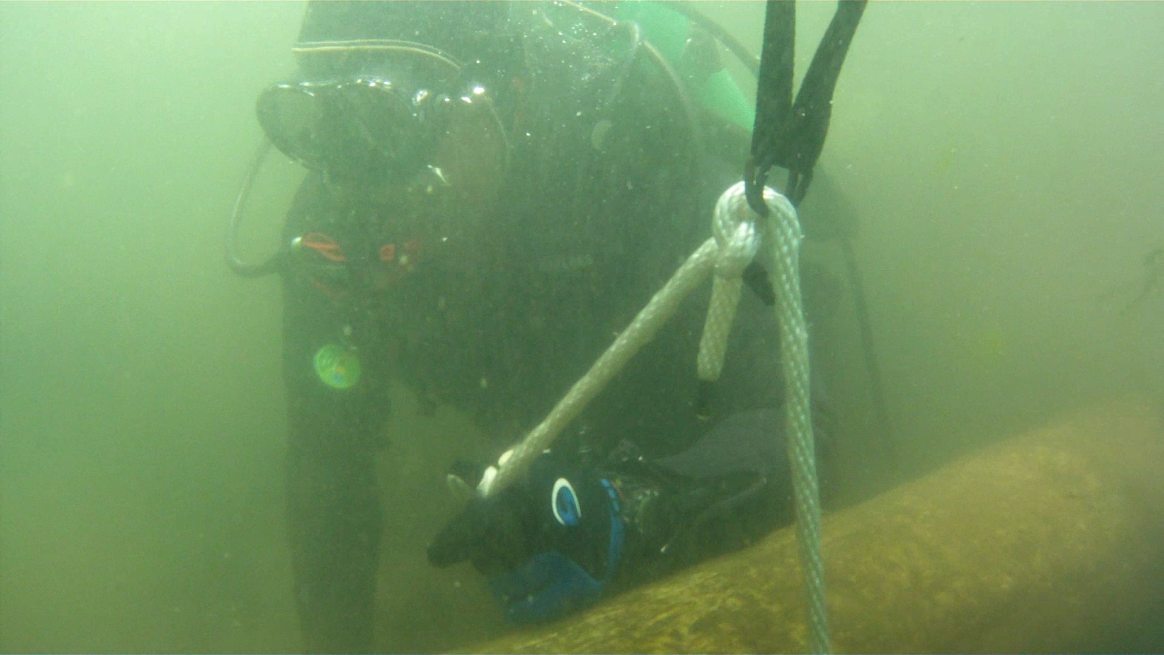
Search and Recovery:  This specialty for me was one of the most enjoyable specialties.  Part of that was the class itself.  As divers we have all seen/read about recovery operations in the news.  Unfortunately they are usually associated with finding accident victims.  Another facet that is not so depressing is finding lost items such as rings, car keys or (sometimes ghost) boat anchors.  The search involves different strategies, skills and drills.  The recovery involves still other skills and equipment such as knot tying and lift bags.

Knot exactly what he expected....
Tater doing some lifting.  Odd choice of gym......
I can say that doing work underwater is way more fun than working on shore.  I can also tell you that diving with a specific purpose is different than just touring around.  Our particular class was made special by the location, the group we were with, and the things we found to recover.  

I also have taken some winter ‘non diving’ classes for specialties in Nitrox and the Equipment Specialist as well as a previously unmentioned Emergency First Responder course.  All good courses but not a lot I can add to give you a feel for what they were like.  OK I could, but this is already getting long winded and I want to spend some words on one more specialty.  
 
One of the most important specialties I took over that summer was Rescue Diver.  Rescue Diver is probably one of the best PADI classes in terms of making divers more complete.  You learn the rescue skills and practice in water rescue skills, but it is more than just a class on how to rescue divers.  It is a class on being prepared and knowing what to do before you need to know.  Yes it is challenging and you will definitely work, you may even get a gulp of water during some drills, but there is a big payoff.  As mentioned in the driving vs. diving analogy, accidents can and do happen.  The reward for taking the Rescue Diver Specialty is being more aware of potential problems, more observant of other divers, more aware of what has to happen and knowing how to take leadership if events thrust you into that role.  It is a specialty that I hope I never have to use to its full extent, but that I do use to some extent every time I dive.  I’m still a noob, but less of a noob after this course.  This course also happens to be a requirement before you can move on to Divemaster or Master Scuba Diver. 

 
Ok, that’s it for the Tater Dive history rehash.  Next time I’m going to discuss my personal decision to head down the path of Divemaster training.  From reading on-line forums, I’m far from the only one who has had a personal debate on what to do.  Yes I am.  No I’m not.   You already know the result, but I will share my decision making thoughts in case someone else is thinking about it.  And if no one cares about my thoughts, for blogging about it maybe Lisa will cut me some slack on scoring all those DM skills we have to do.     Right Lisa? ….  Lisa?

Sunday, February 17, 2013

GUEST BLOG: The Tale of Tater

Allow me to introduce myself to the Team Manta world.

They call me.... Tater.
Hello, they call me Tater and I am a Scubaholic.   Ok now that we have the formalities out of the way, why is it that I am writing on the Manta Blog?   I’ve asked myself the same question.  I’m not much of a writer or even a good speaker for that matter and this is definitely my first blog post of any kind.  The reason I am here is that team Manta at one point asked me to be a guest blogger about my experiences of being a Divemaster Candidate (DMC).  When my instructor, Lisa brought up, I pretty much ignored the request, hoping it would go away!  Actually it did, so I thought I had escaped.  The more I thought about it though, the more I came to the conclusion that one of the many reasons I am a DMC is that I enjoy SCUBA so much that I not only enjoy the dives, I enjoy sharing SCUBA with others.   So while I hate spelling, grammar and word-smithing, I will give it a shot at sharing my experiences with you and hope it helps someone else with questions of what it might be like.

I am on what I call a slow track towards being a DM in that I am in no rush to get ‘certified’ and feel the longer it takes, the more experience I will have when that time comes.  In other words, I have plenty of time for blogs.  So where do I start?


It all started when I was 8year old…Just kidding, but only sort of.   I am of the generation that actually watched Mike Nelson and Sea Hunt when it was on TV and the signal came over an antenna!! Imagine that!!  I was also a fan of Flipper and Jacques Cousteau.  So the seed was actually planted when I was little.  
When I was a freshman in college you were required to take a fitness course to graduate (wow) and one of the options was SCUBA.  I couldn’t have afforded it on my own, but as part of my tuition it was pretty much free to me, making it an easy choice.  I got certified through UW-Parkside by Water World in December of 1980 at the Racine Quarry.  I loved it then and used to drool over the photos in Skin Diver Magazine each month and dream about tropical diving.  But alas I didn’t get much actual diving in and my struggle to carve out a life pretty much put SCUBA on the back burner.


Fast forward to 2010: Having never taken real vacations (other than camping) when our kids were young, my wife and I decided to go someplace exotic and tropical for our 25th anniversary.   Searching the internet for places to go, I was reminded of the pictures from Skin Diver and started to think again about SCUBA.  Discussing my possible plans with co-workers, I discovered one of them was also a certified diver, but he too hadn’t dived in a while.  We decided to take a refresher course together.  I did an internet search for local dive shops and sent off some email questions.  Based on the responses and a discussion with potential shops, I felt that Manta would be the best shop to work with.  My dive buddy (J.0) and I took the refresher course with Manta.  After the book review, we did a brush up in the pool, and then some open water dives in local quarries with team Manta and also on our own.  I was hooked again. 


I did make it to the Bahamas’ and got in a couple of fantastic dives.  Lot’s of firsts for me; my first time in the ocean, boat dive, drift dive, shark sighting (within 3 minutes of hitting the water), Rays, Parrot fish, Hog Fish and much more.  I was not only hooked, I swallowed the hook.


Fish, fish, everywhere!


From that time on, I wanted to increase my skills and diving knowledge.  I began taking more advanced/specialty classes with Manta.  I’ll share some of that training and what it was like in future posts.  Until then, check out the Manta Calendar, maybe I’ll see you in a class.