Sunday, June 29, 2014

Stories from the Repair Bench

Picture #1
It’s always sad when divers bring me gear that can’t be fixed or repaired, not because it got to be too old but because of improper care.  It’s also expensive. Take the diver whose dive computer gave up the ghost prematurely.  It didn’t have to happen. After close examination it was obvious that the diver’s air integrated computer with quick release  had not been properly rinsed after diving. ( see picture 1) Note the salt build up on the threads, O-ring and the bayonet quick release. It was obvious that without proper rinsing the salt dried the O-ring allowing salt and moisture to get into the computer.  End of computer.  You should always thoroughly rinse your gear at the end of every dive day. If you have done repetitive dive over many days it’s always a good idea to soak your gear overnight after washing it with recommended shampoos. This is true in fresh or salt water. While the aforementioned computer was the victim of salt water , fresh water can be just as harmful. Improperly rinsing in fresh water grows harmful bacteria. Check out picture #2. This diver regularly “Dipped” his regulator after diving to rinse it. That green stuff in and around the mouthpiece is mold. I didn’t take pictures of the interior but they were just as bad. It could have been avoided by flushing the inside of the regulator with clean water.
Picture #2

There are a lot of divers out there doing their best to keep repair technicians busy.  I was recently talking to another technician from the Chicago area and we were both sharing equipment horror stories. At one point he got out a box of little baggies containing things that they had found in regulators over the years. There was sand, gravel, hair, shells and plant to name a few. The best was the regulator that a diver brought with the complaint that it that tasted funny. No matter what tank he put it on the air had a horrible taste. My friend held up the baggie t contained the cause of the bad taste. It was a frog the got up into the regulator and after passing on dried to the inside of the regulator box. GROSS!  Remember, take care of your gear and above all, rinse all frogs out of it!


MIKE

Sunday, June 15, 2014

Fighting the Invaders

Well, never let it be said that Manta Divers does not come up with some really different activities for divers. If you follow the blog at all, you will recall that yesterday was our day for picking weeds underwater.  We did and it was a wonderful day.

We left the shop at 7AM and headed out to Troy, WI and the Nature Conservancy’s area on Lake Lulu.  While we were setting up our gear, Mike and Southeastern Wisconsin Land Steward, Jerry Ziegler, set the dive flags to mark off the area where we would be working to carefully remove invasive Eurasian Water Milfoil (EWM). 

With the dive flags set and our scuba kits assembled, we boarded the pontoon boat and headed out.  Surface support included Jerry, Mike, Kathryn and Jerry’s intern, Elizabeth.  Their job was to keep an eye on the divers, look for any stray EWM, exchange full collection bags for empty ones, and make sure that boaters obeyed the law and stayed 100ft from our dive flags.
Photo by Kathryn Elliott
Meanwhile, underwater, Sheryl, Chris, Brandon, Ken, Tater and I were diving in teams with one person carrying a mesh collection bag, and the other diver picking milfoil.  We were to find the offending plants and carefully pull them out, trying to get the roots as well as the rest of the plant. When we had our mesh bag full, we called for Elizabeth and she paddled out in the canoe to take our full bag and give us a fresh one to fill. 
At first, it was slow going, with only occasional small plants being found. I thought to myself, ”Wow, they really are winning this battle!” I was wrong, though, because as we continued to sweep the lake bottom, we were coming across large patches of the plant.  When we found the patches, both divers would pick, roll the long branches up in a bundle and place it in the bag.  You can guess what happened as soon as we started to pull up the plants.  Good thing for us, we would pick as long as we could, then move to another, clearer spot, pick there and then return to the previous spot.  Usually, the sediment cleared up enough that once again, we could see more plants to pick and our buddy.

Meeting the other dive teams at the surface, we would excitedly state that we “found the mother lode” and show off our bags.  We all enjoyed finding the big patches and clearing out so much milfoil. Jerry was really impressed with the amount of weeds we removed, and was so excited to have volunteers with our skills.  We were able to remove so much more than the snorkelers he has had help in the past because we could stay down for 30-40 minutes at a crack.
Photo by Kathryn Elliott
We dove for a couple of hours then broke for lunch, Mike cooking brats and hot dogs, and the rest of us sharing fruit, chips and other snacks.  Fortified and rested, we then swapped our tanks for fresh ones and hit the water again. 

It was a great day, fun and productive.  The only negative thing was a run in with some boaters who did not know that they were to stay 100ft from our flags and who, when informed of the law, expressed great displeasure that we had the audacity to take their spot in the lake.  The irony, of course is that we would not be doing this clean up if it weren’t for then I the first place.  They bring their boats through the river channel into Lake Lulu from another lake that has a EWM problem so severe that they have to use chemicals to control it. The EWM gets wound around their props and when they reverse them in Lake Lulu, the plants are deposited in the water where they float to the bottom, root themselves and start a new patch.
Photo by Kathryn Elliott

There are self-absorbed idiots everywhere, but fortunately, there are more people who are on board with trying to stem the spread of these invaders, who participate in these clean-ups and have fun doing it! 

Sunday, June 8, 2014

Neal Skrenes: Six things to know about Dive & Travel Insurance

Neal Skrenes
After a recent event that caused the cancellation of a dive trip three years in the planning, Mike and Lisa asked me to write about my experience with dive and travel insurance. So here are six things I think you should know about dive and travel insurance.

1. Be aware that Dive Medical Insurance and Travel Insurance are not the same thing, and that many Health Insurance Policies may not cover diving-related injuries or expenses.

I am a firm believer in Diving Medical Insurance and have been a member of DAN¹s Master/Premium diver policy since I first became aware of them in 1988. Other divers belong to other programs; having coverage is more important than which program you choose.

Something that not even all DAN members know, or understand, is that basic DAN insurance IS NOT TRAVEL INSURANCE, per se.

While it¹s true that DAN membership also includes a form of travel interruption and cancellation insurance, in order for DAN¹s medical evacuation policy to take effect, you must be ill enough to require evacuation to make a claim. DAN trip cancellation coverage only covers the DIVING-RELATED portion of your trip.

For example, if you booked a flight/room/diving trip to Bonaire and come down with a cold or ear infection, only your dive trips on the boat would be covered by DAN . . . because, according to DAN, you can still sit on the beach with a cold.

2. All dive accident policies require care to be first prescribed by a medical professional, documented in an itemized bill, reported to the insurer in a timely manner and other important details. You¹ll need to follow your policy rules to ensure coverage, not always an easy task in remote areas.  Sick as I was, I knew I¹d need proof that I had seen a doctor or visited an emergency room, so I asked for and obtained copies of the doctor¹s notes and the bill for services and medications. I also planned to see my own doctor as soon as I arrived home.

I think the main thing that confuses some divers about DAN is that the trip cancellation/interruption insurance included with DAN Preferred is that it applies only to diving-related cancellations:

"This benefit pays for the losses described below that an Insured Person incurs for a trip canceled up to the time and date of departure for a Sickness or Injury that would substantially impair his or her ability to dive. "

But it's not general-purpose travel insurance; it doesn't do anything for you if a hurricane wipes out your trip, someone dies, there are travel delays, lost baggage, etc.

3. As I began traveling to exotic destinations, I realized I needed coverage over my trip costs. Fortunately, DAN also realized this and offers "travel insurance² packages through its website.

Note that cancellation insurance must often be purchased and paid for within a specified number of days from the date that the trip¹s first deposit is due to be paid.

4. You aren't likely to need trip cancellation insurance if you're just getting into the car and driving 50 miles to the beach (or quarry). However, if you¹re planning a major dive trip that requires paying out a good deal of money and flight time, it¹s something to consider and I hope my advice is helpful.

5. What Good Travel Insurance Covers:
Cancellation - You become ill and need to cancel your trip
Missed Departure - A road traffic accident or some other delay causes you to miss your flight
Vacation Abandonment - Airport strikes cause you to abandon your trip altogether. (Cancellation is the one of the more common reasons people claim on their travel insurance policy); In my opinion, it's bad enough not being able to go on your trip, without the added blow of losing the money that you've shelled out, too.
Medical Expenses - You need to go to hospital, this can be very expensive should you need surgery. Medical expenses can be incredibly high in foreign countries; this is perhaps the most important reason for buying travel insurance, and consequently is the most claimed against. Do no underestimate how expensive medical bills can be!
Baggage - Your bags get lost or delayed in transit and you need to purchase new clothes to wear
Curtailment - There's an emergency at home and you need to go home, cutting your trip short

6. Points to Consider When Buying Coverage:
A common mistake is leaving travel insurance until the last
Minute. The best time to purchase your policy is as soon as you have booked and paid for your holiday. By doing so, you¹re saving money should you need to cancel your trip or if a strike is announced that disrupts your travel plans and you need to make alternative arrangements.

Lost Equipment Coverage generally covers only diving equipment that is worn on the diver's person that is "cut loose" and is lost or damaged as a result of a Covered Diving Accident.  For full coverage of lost diving equipment you should have separate sports gear coverage added to your home or renters insurance policy.


In my case I was glad to have purchased both DAN Medical Insurance and DAN Travel Insurance - though I missed out on some long anticipated diving I received adequate compensation so that I did not lose most of my non-refundable trip expenses.

Sunday, May 25, 2014

I got my GOES card

It’s not a card issued by AARP that confirms my ability to GO. On recent trips out of the country, Lisa and I noticed the Global Entry lines.  There were few people in them and the ones that went into those lines moved through them in quick fashion.  A friend who travels for his job told us we had to get the GOES card and it would truly be worth the $100 you pay for the application. After nearly missing a connection at the Miami airport due to excessive slow moving lines, we decided to do it.

GOES is the acronym for GLOBAL ONLINE ENROLLMENT SYSTEM.  Global Entry is a U.S. Customs and Border Protection program that allows expedited clearance for pre-approved, low risk travelers upon arrival in the United States. There is no minimum number of trips necessary to qualify for the program. Participants may enter the United States by using automated kiosks located at selected airports. To get a GOES card, you have to agree to divulge a lot of personal information.  Face it: this information is already available to the government, so as someone with no terrorist links or desire to conduct international illegal business, I don’t have a problem laying it out for them.  You go to the Global entry website,  (https://goes-app.cbp.dhs.gov/main/goes) and register.  After your application is submitted and your check clears, you will get a letter directing you to make an appointment for an interview. At the interview, you will be photo graphed and your fingerprints are recorded.  The officer will question you about where you travel, what your occupation is, and if you have any outstanding criminal charges.  Assuming you answer to the officer’s satisfaction and everything checks out, you will be mailed an ID card in a protective sleeve to carry with you when you travel. (The protective sleeve shields the RFID chip in the card so your information can’t be accessed.)

Once you receive and activate the card, you can add that ID number to airline reservations to mark your travel documents to indicate that you are a trusted traveler.  This really smooth’s the road through the airport! Once check in luggage is dropped off, GOES participants proceed to the shorter Global Entry line to TSA check in.  In that line, GOES ID holders do not have to take off their belts and shoes, and the search is less invasive.  A word to the wise, though, if, like me, you have artificially parts that set off the metal detector; tell the office right away.  They will then direct you to the front of the line for the millimeter scanner.  If you say nothing and set off the metal detector, they have no choice but to perform the usual pat down.
 
At major international airports, they now have kiosks for reading the traveler’s passport.  GOES participants have a special expedited line for this as well.  Once your passport is scanned, it will print out a “receipt” that shows your photo on it.  If there is an “X” over your photo, then you will have to talk to the immigration officer.  For a non-GOES traveler, this is another line to wait in, but for the GOES traveler, you will be put at the head of the line again and bypass all the waiting.  This is a really good thing if you are someone who has difficulty standing for a length of time, as this pass cuts through all that and keeps you moving along.
On our recent trip to Utila Lisa  and I both traveled with our new GOES cards and it relieved much travel stress by allowing us to navigate the customs lines so quickly.


On our way back into the country and to our connecting flight, we were also among the first people to get to the baggage claim and back though TSA check in.  (If only they had GOES for luggage!) Getting our GOES card cost $100 but was a small investment towards  more enjoyable travel.

Sunday, May 18, 2014

Tales of Tater: Dive Software Test


One of the first things we learn as divers is to fill out our log books.  It's important to keep track of the number and details of your dives especially as you progress with more advanced training.  I log each one of my dives and include notes, sites dive buddies etc.  The technical portions of the dives are copied off of our dive computers.  Items such as depth, time, dive time, surface interval etc.

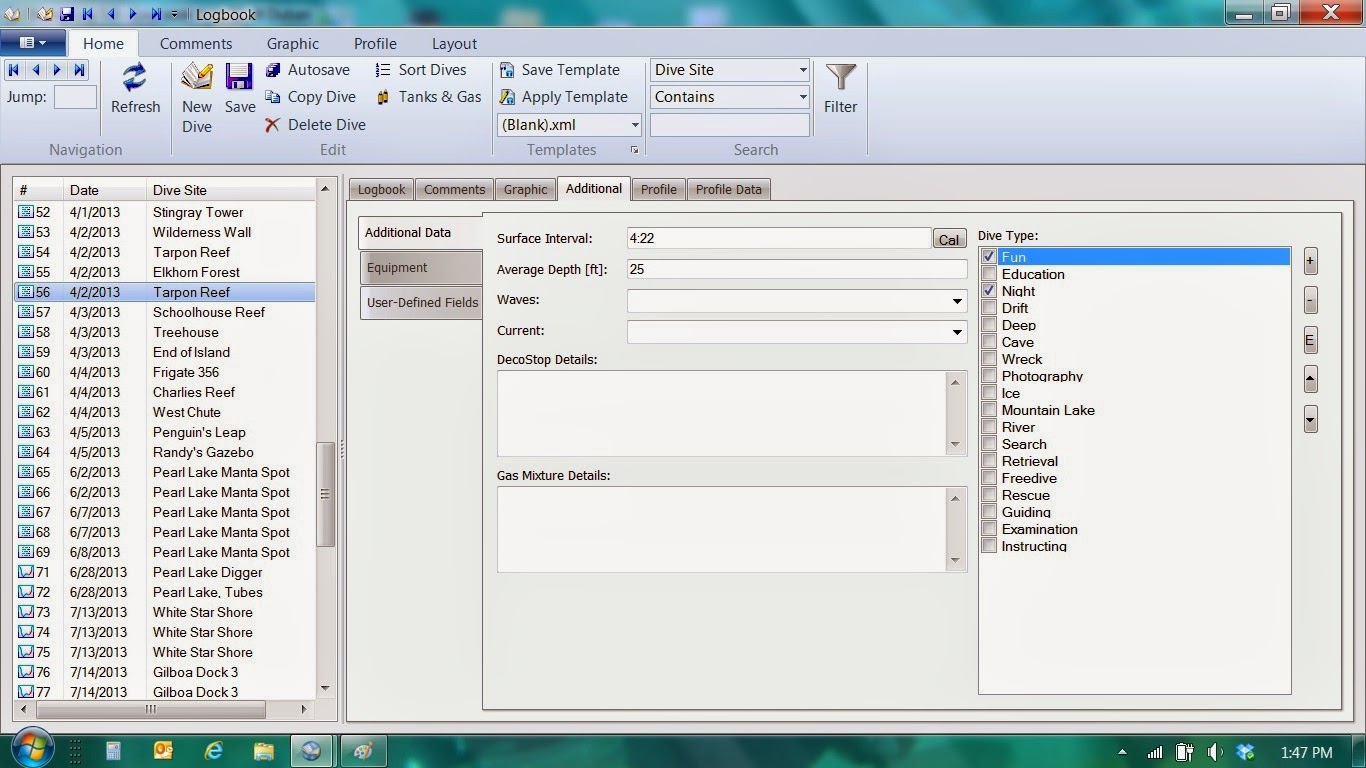
With modern dive computers comes the ability to communicate from computer to computer.   Now we can download the information stored in the computer to a PC.  What`s the point of that?   Well actually there are several. I dislike the process using my thumbs to navigate through the menu on the dive computer.  I would rather let the computers do that.  I also dislike writing down all the technical details mentioned earlier.  It isn't terrible but I prefer to do it all at once when I feel like it rather than right after a dive.  I also like the ability to tie pictures that I've taken on a dive to the specific log off that dive.  It makes them both more interesting together.  Finally the biggest reason to do that is that I am a dive geek, in mathematical terms; Diver + Geek = Dive Geek = Tater. 

After spending some time on the Google machine to investigate, I found one of the packages that sounded the best was called Dive Log 5.0., the problem with it was the cost; roughly $50.  As any tightfisted engineer would know, you just don't plunk down some cash based on the marketing of a product.  But a good manufacturer will understand that and let you try it.  I downloaded the free demo and started to play with it.  I was not completely sold (Manta and/or my wife will enthusiastically confirm that I don't buy anything quickly)

$50 is a lot more money than my log book refills!! On the other hand since I don't have any quarry fees, motel stays or dive refreshments to buy until summer, $50 for a onetime fee doesn't see too terrible.  In a weak moment I pulled the trigger and ordered it.

One of the features I like the best about the software is the ability to connect my dive computer to the laptop and just download the most recent dives. I simply connect the cable from my Suunto Vyper to the PC using the provided USB interface cable, go to the download menu in Dive log 5.0 and press the button.  Dives are automatically added to the end of the existing dive log.  You can then edit anything about the log entry including the dive number.  This is a real must for several reasons.  First if you are like me you may want to enter a bunch of dives from before you got the dive computer.  Second, I don't consider every dive that my computer logs to be a separate dive.  Sometimes we just surface to adjust gear, get our bearings, help a student etc..  I often combine dives after they are downloaded.   I can take what the computer calls 3 separate dives of 3 minutes, 10 minutes and 15 minutes respectively and just modify the log into 1 dive of 28 minutes.  If I take my dive computer into a Manta Pool Session it gets logged as a dive and I can just delete that one. 


The details that are downloaded to a log will vary according you your dive computer.  A dive computer such as the Atomic Cobalt provides a lot more information that does my Suunto Vyper, but I have the ability to add to or overwrite any information that is downloaded.

Once you have the dive information logged in correctly you can really start to use the software as you like.  I always like to add a few notes to each log just as you would in a logbook version such as what fish you saw, who your dive buddy was, visibility etc.  There are a lot of built in information in the software that you can use such as dive buddies (which it keeps track of so you can just pick names or groups on subsequent dives),  Tank Pressure, etc.  You would sort of expect that in an electronic log and it is all there.  In addition, there are categories of dives that you can use such as Night Dive, Deep Dive, Teaching, Leading, etc.   These items are also tracked for other uses. But wait, there's more!!

One fun little tool is that you can use maps to track the location of your dives.  Not just say 'Pearl Lake' but you can attach an actual map location to it as you might with Google maps. This information is also stored and can be selected on future dives.

Another fun and/or useful things that the package does is give you the ability to get statistics from the stored dive logs such as how many of a particular type of dive, location of a dive, how many dives with a particular dive buddy,  how much total time under water, number of dives in a location etc.   Nothing like a nice graph to get a geek's heart racing :)

Probably one of my favorite features is the ability to add pictures to the dive log.   I take a fair number of GoPro pictures and while I sometimes make YouTube type videos out of them, I almost as often grab snapshots out of the video.  There is a drawback here that the software does not support video.  I spoke with the developer and he is hoping to add that to future versions but for now it only supports pictures.  You can attach pictures to each dive so that 2 years from now flipping through your log, you can tie the photo to the specific dive and dive log information.  I really enjoy this because I can now take the pictures from say Cayman Brac and directly tie them not only to Cayman Brac, but the specific dive, dive Buddy depth, dive site name etc.   I find that connecting the picture with the dive specifics makes the picture more interesting and also the dive log entry more interesting by tying the memory all together.  (This is especially helpful as I get old, senile and get in more dives)


 But wait!  There's more!!  Aside from the advantages of the software, they have a working relationship with other software vendors for both Android and Mac.   Who cares?  Well there is a big advantage there in my book. 

Many of us have done dive trips to remote tropical locations.  One of the big problems with flying with dive gear is packing. Weight and space for a dive trip are at a premium and can be very expensive if you go over the restriction.   Well one of the things I carry with me on trips is my laptop.  I have an older 15" Dell that I take mostly to use with my GoPro so I can download the video.  Mine weighs a few pounds and is about 2 inches thick.   What if I didn't have to take it?  What if I could use a 7" tablet and download save all of my video files to the tablet or a memory stick?  Well I can.  And now I also have the ability to download my dive computer to my tablet.   Dive Log 5.0 works with an Android application called Divemate USB.   I can load all of my electronic dive logs (minus pictures) onto a cloud application called Dropbox and use it to transfer all of my log information onto my Android tablet


as well as my phone using Divemate.  


It is a separate application but holds all the same information except the pictures (pictures can be added to but are not automatic and I wouldn't waste the memory space).  It is two way sharing in that I can also use Divemate to download new dives from my Vyper directly to my tablet and Divemate will allow me to transfer the information back to my PC and the Dive Log software through the Dropbox.  Oh man Jimmy Ray you gotta be lovin' this!!!

I love the fact that I can use both packages for the same information and each has some advantages.  For example Divemate has a built in feature of combining dives, which I previously mentioned I do manually in Dive Log.  But I much prefer the Dive Log software because of the statistics and generally more comfortable viewing on the larger screen. 

I don't claim this is for everyone and there are a couple of drawbacks.  If you want to log previous dives to catch up to your current dive (which you do not HAVE to do) you either need really good information or it can distort some of the statistics that it produces.  For example if you don't have a detailed record of your tank pressure delta on a given dive or dives, it will be included in your SAC calculations and can throw that off.  

If I lived somewhere I could dive 150-200 dives a year, I might skip all the features and just use it because it was easier but since I generally have several months of the year where all I can do is dream about diving and re-live past dives, I really do like the product and messing around to find all kinds of things such as number of dives at a given depth, temperature, number of dives by month, number of dives with particular dive buddies, training dives, night dives etc. as well as being able to put the right pictures with the right dives. And oh boy, who doesn't like a good graph??    But wait, there's more!!


Call Manta Divers now and get a free air fill with any gear purchase over $200 with one easy payment.  Yes you heard right, that's a $10 savings if you call now.  Operators are standing by.

Photo Credit: All Photos in this blog post are the work of Scott Durban

Sunday, May 11, 2014

Utila Part One

Hey Blog readers!

Did you miss me?  Sorry about the lack of communication.  As you know, we were in Utila over Easter and the internet connection was a bit spotty and, truthfully, I was really too busy diving to write!  I guess that is a good thing.  I did manage to post a couple of videos to Facebook there showing a brilliant red sea horse, the Halliburton wreck and our whale shark encounters.

Utila is one of a few destinations that I never tire of.  It is remote and fairly primitive compared to places like Cozumel or Aruba, but that quality is what draws me there.  I especially love staying at Utila Lodge, an eight room all inclusive resort.  The rooms are literally over the water, so guests can be lulled to sleep each night by the sounds of the ocean.   The food that is prepared there daily is not fancy at all, but is nutritious and well balanced: salads, fresh fruit, barbequed pork, baked fish, shrimp, chicken and other dishes sure to satisfy after a day of diving.  The desserts, though, were a highlight, my favorite, though were the snickerdoodles!  

The weather was fantastic: 87F plus on the land, and 83F in the water.  Kisty Engel, the resort owner, is a friendly, fun person and was a wonderful host to our group. She and her late husband, Jim pioneered diving in Utila, building the island’s first dive resort, first hyperbaric chamber and setting up the first permanent moorings.  We have much to thank them for as this island has some of the most beautiful reefs and marine diversity around.

As I mentioned, our package included three dives per day with two night dives.  Willie, our dive master, was great at spotting critters, such as mushroom scorpionfish, sea horses, arrow blennie, decorator crabs, juvenile spotted drums and tiny hermit crabs. Though dive leaders tend to ignore the sandy areas of the reef, Willie showed us how interesting they can be by spotting tiny hooded sea slugs, pipefish and a northern stargazer on our night dive.  Each dive was better than the last.

I’ll write more about our adventure next time, but in the meanwhile, enjoy this YouTube of day one in Utila. 

Sunday, April 13, 2014

Let the Schlepping Begin

With the long winter over (I think its over.)I’m looking forward to the dive season opening up. The schlepping begins well before the season though. What this schlepping you say?  I looked it up in the dive dictionary:

Schlepping (sch-lep-ing) : the logistics of the  coordination, handling, loading , unloading and movement of copious heavy dive gear, repeatedly.

So when you help load the tanks, gear bags and other equipment into the dive van or trailer your helping to schlep the gear. Schlepping is an integral to diving and is actually part of the Dive Master training.  Ask Tater as he has completed his dive master certification.  We can’t dive if the gear doesn’t get there.

There’s a lot of background to schlepping that most people never see. Start with filling the tanks. It looks like you just hook up the tank to the fill whip and open the valve. What you don’t see is the filler’s quick inspection to the tanks. It is important to make sure that no damage that result in an explosive situation has occurred since the last fill. All of our tanks get the mandatory annual inspection every February.  After the tanks are filled, we stage the tanks for loading. Most of the summer, I load them directly in the trailer after filling.  

When we load the van and trailer a lot of thought goes into where the weight is placed in the vehicles.  In the van we try to keep the combined weight of passengers, gear on trailer tongue weight below the recommended tire load rating for the tires on the van. On my list to do this spring is to take the van and trailer to Kenosha Tire to have the tires inspected, much like you have you regulator and gear inspected. They may determine that new tires will be in order.  The same weight issues are considered in loading the trailer. We try to balance the heaviest weight over the axle.  We also pay attention to the distribution of weight from the front of the trailer to the rear. Too much weight towards the front of the trailer causes excessive tongue weight thus putting excessive weight on the rear of the van and exceeds the load rating on the rear tires.  Too much weight towards the rear of the trailer causes the tongue to lift the back of the van and the trailer will sway back and forth. This shifts the weight of the cargo from one trailer tire to the next. When most of the weight is shifted to one tire it exceeds the recommended load and the tire overheats and blows out.  In addition to balancing the loads, inspection of the van, trailer and tires is a regular ongoing activity. I even check the temperature of the tires at every pit stop with a PYROMETER while on the road.  However, even with the balancing of the load and constant inspecting, occasionally you can still blow out a tire.


 Last summer on our way to recover the famous Ghost Anchor of Butternut Lake we blew a trailer tire by Appleton. (We blamed the blow out on the Ghost Witch of Butternut Lake. Legend states that she placed a curse on anyone attempting to get the Ghost Anchor out of the lake. Later that day she threw a deer at the trailer. That’s another story though.)  We had been diligent on balancing the load and checking the vehicles and tires but still had a blowout. On the trip the tire temperature’s had been running between 105 to 110 degrees. The same temps that we ran all the way to Ohio and back a few weeks earlier.  As we were weighted just less than the Ohio trip we determined that the blown tire must have picked up a nail or other road debris and began to lose pressure.  This made the sidewall of the tire to bulge and flex caused the tire temperature to increase rapidly exploding the tire. The tire blew with such force that it took the fender right off the trailer. As the driver, I was happy that the load in the trailer was evenly balance as it made keeping control of the vehicles and getting off the road much safer. A few years ago I anticipated (as any good schelpper would) that this could happen thus the tool box and spare tire that I had welded to the front of the trailer. We were back on the highway in about 20 minutes. Just before we got back on the road I checked the tire temps on the van and trailer. It was about 20 minutes after the blow out and they were about 100 degrees. The blown out tire was still registering well over 180 degrees. I wonder what it was when it blew.

In the next few weeks I will be picking up the trailer from storage. It’s been in a heated warehouse during this nasty winter. Before the season starts I hope to finally complete the interior and install some lighting.  If I don’t get the interior finished and lights installed you can still be assured the inspections will get done and all safety issues addressed.  It’s just part of the schlepp.


Mook