Showing posts with label Dive Specialities. Show all posts

Sunday, March 16, 2014

Rescue Diver

Hopefully, since we are now getting short glimpses of spring, divers are starting to plan for outings and courses for the summer.  Open water divers will want to schedule their adventure dives for Advanced Open Water. For those who want to delve more deeply into a particular dive experience, specialty courses, such as Underwater Navigator, Peak Performance Buoyancy, Wreck diver and Night Diver are your ticket.  But if you are a diver who really wants to stretch his skills and expand from caring just for himself to caring for others, then Rescue Diver is the course you want.

There are many reasons people give for wanting to take the Rescue Diver course beyond just a stepping stone to Divemaster or instructor.  For example, a diver may have a child or loved one as a dive buddy, or they are the most experienced diver in their group.  These divers feel that others are relying on them to be ready to help if there is an emergency, so they want to prepare themselves.  Sometimes, the diver was a witness to an emergency and didn’t like having to stand around not knowing how to help and have vowed to be ready the next time.  Whatever the reason a person takes the Rescue Diver course, they always come away saying that it was the most challenging and rewarding course they have taken.  As an instructor, it is so rewarding when a former student shares a story of how their training kicked in at the appropriate time. 


Here is an excerpt from an e-mail we received from Sarah Barrett, a student of ours who has recently earned her dive instructor certification in Florida:

“Two days before our divemaster course was over, we were teaching an open water class with two open water students: Sam, who was 67, and actually his dad who was probably in his 80's. We had done some of their confined water skills in the morning, and then in the afternoon we took them both out for the open water dives. On the second dive towards the end, I looked over upon ascent, and Sam was signaling to another kid in my class that he was out of air, although you could see he was still breathing from his primary. Aaron, the kid in my class, gave Sam his alternate anyway, and they ascended together. Once we all got to the surface, Sam spit his regulator out of his mouth and started yelling "It felt like I wasn't getting any air!" over and over again, so we calmed him down a little and said it was time to swim over to the boat. While on our way to the boat, we were holding onto the mooring line, and Sam tried to grab a piece of it, but over and over again would grab the air-we immediately knew something wasn't right. Claude, my divemaster instructor, said "Sam are you ok?" and Sam kept saying "No." Before we knew it Sam had put his head back in the water and fell unconscious. Me and Aaron immediately started towing Sam back to the boat as fast as we could, while Claude removed his weight belt, and we unclipped his gear as we got closer to the boat. Claude yelled to the captain that we had a REAL emergency, and I yelled at the first mate to get the O2. This was the scary part-Sam's face was so blue it scared the living crap out of me. I had never seen anyone look that blue before. As I kept Sam's airway open, we all lifted him onto the back of the boat (and he was probably 250 so it wasn't as easy as it sounds.) We then got him onto the boat and gave him oxygen right away, and within a minute or two he was able to open his eyes and tell us that he was ok. After we got back to the canal obviously we had to meet the ambulance and the coast guard, and Sam was taken to the nearest hospital. He is ok and his dad, Jim, actually came back the next day to finish his open water.
             Needless to say I was blessed to have had my rescue training with you guys, because right when Sam went unconscious, I didn't think, I just acted. It felt amazing to have helped actually save someone's life, and I just wanted you two to know that you did an amazing job in preparing me for a situation like that. I'm also glad it had such a good ending and that Sam was okay!”

The course starts with the prerequisite Emergency First Response course.  In the EFR course, the student learns first aid, CPR, AED and oxygen use.  During this course we start to introduce some diving scenarios in order to start participants thinking how these skills apply in a diving situation.  Moving into the actual Rescue Diver course, we spend a couple of nights in the classroom working our way through the manual. Then the fun begins! We spend an entire day practicing rescue skills and playing out some situations with the help of volunteer “victims” in open water.  The next day, we return to the open water where the instructor and volunteers set up real life scenarios that the Rescue Diver candidates must react to and act upon. Scenarios are played out until each candidate responds appropriately and with confidence.  It is exhausting and exhilarating at the same time! Best of all, successful candidates earn not only the certification card, but the coveted Manta Divers’ red touque.

Emergency First Response course is scheduled for April 1 & 3 at 6:30 at the shop

Rescue Diver course is scheduled for May 20 & 22, classroom, June 6 & 7 open water training.

Sunday, August 25, 2013

A Busy Day at Pearl Lake

Yesterday we had a busy day at Pearl Lake, teaching three Open Water students, two Peak Performance Buoyancy students, and one Rescue Diver. The rescue course, the last step before professional diving courses, is particularly fun to teach. Through the course study and the skill development, the instructor gets to see the student’s transformation from an independent minded diver to one who cares for others at a high level. The other aspect of the course is that we enlist the help of other divers to serve as victims, our preferred choice being successful former Rescue Diver students.

As our rescue student, Sarah Barrett, was communing from Indiana to take our course, and under a time crunch, we made a special class for her. In the pool, we were lucky to have Manta Diver Kathryn Elliott, who just happens to also be a lifeguard trainer, act as victim for skill development. She challenged Sarah to deal with simple rescue of tired divers, to full on irrational panicked divers, to finding and surfacing with an unconscious diver, as Mike coached Sarah through the exercises. Kathryn was a huge help and it showed in Sarah’s performance in the open water.


After skill development, Rescue Diver students must apply what they have learned in the open water through a number of scenarios. For this portion, we enlisted the help of Sheryl and Jerry Brandes, who took the rescue course last summer. As recent graduates of the course, they bring a special talent for playing the victim and their input during debriefing provides a unique perspective. In addition, as with everything we do, we want everyone to be safe, so having a number of rescue divers on site is always a plus.

At the end of the day, not only do we thank everyone who helped in getting Sarah through the course, but we hope everyone, including the newly certified divers, learned something or took something away from the exercises, be it a skill, or inspiration to work toward becoming a rescue diver themselves.

Sunday, April 21, 2013

Searching Davy Jone's Locker


I was asked last week what specialty I like to teach the most. I gave it some thought.  I like a lot of them, Underwater Navigation, Equipment Specialist, Wreck Diving etc.  But the one that I come back to the most is “Search and Recovery”.  I have thoroughly enjoyed teaching this specialty.  The two pillars of search and recovery are 1) something is lost or 2) something needs to be recovered. The something is lost can be a variety of things. For example, a set of keys has been dropped overboard, wedding rings left a hand during a water volley ball game, an outboard jumped ship or a prop was there then it wasn’t.  The search starts with getting as much information as you can before you start the search. I talk to as many people that were there and saw what happened as I can.  Nobody ever remembers everything about where the boat was when the keys went into the water or when the outboard jumped off the boat but by interviewing a number of people you can get a better idea of the area that you will search.  Another tidbit of information to consider is the ability of the item to drift to the side after it enters the water.  Keys on a ring tend to whirlybird to the side as much as 6 -10 ft. from where you saw them go in.  Gold rings or heavy outboards tend to go almost straight down but a prop only comes off in reverse and will spin sideways and back as much as 25 – 30 ft. In that case you really need to know the position of the boat when the prop left it.
I found this prop using a sweep search, feeling my way along the bottom in zero visibility
Used a 50 lbs lift bag
After the information gathering is completed you the have to determine how you are going to search and what equipment you will need. Sometimes you will need the assistance of one or more other divers and it becomes a group adventure. The location and area of search will often dictate the search pattern.  In the case of the outboard, if the visibility is good you can do your search up off the bottom using an expanding box search with your compass. Low or zero visibility will require a search on a line feeling your way along the bottom. I do this type of search a lot.  In the case of the rings you may have to use an underwater metal detector. This is what I used to find the wedding rings in the picture.  It’s fun to investigate and set up the search.
I used an underwater metal detector on this find.
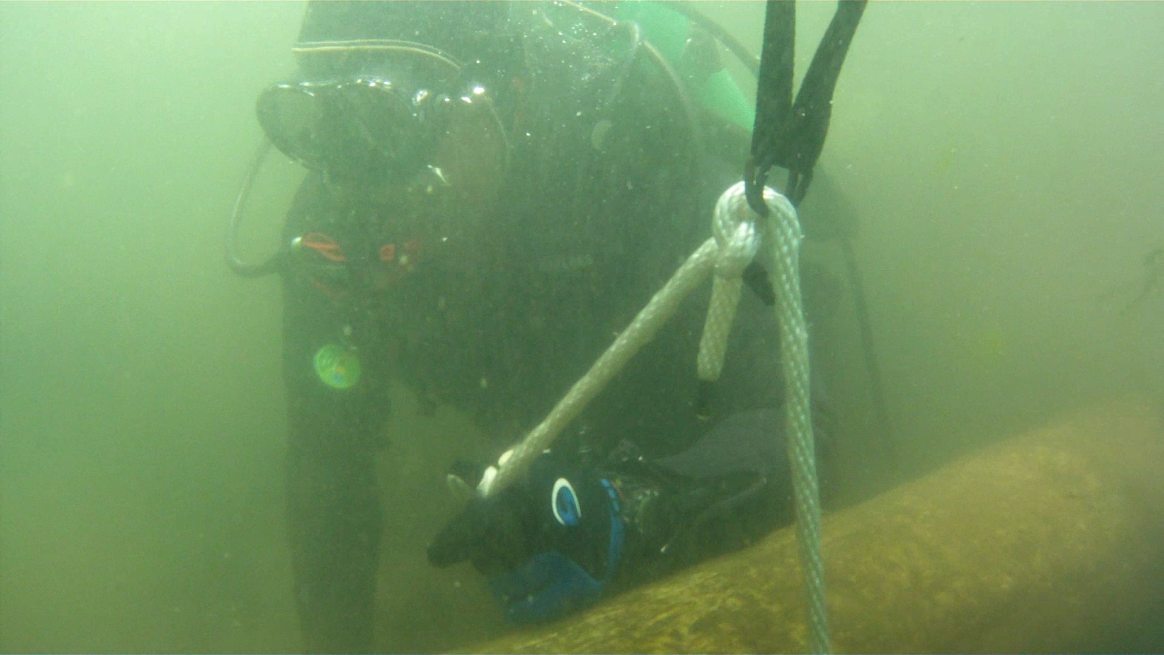
Recovery starts after your search finds what you’re looking for. In the Search and Recovery course we learned the use on knots and had some fun with lift bags. When you find something small like the wedding ring or keys recovery is a no brainer. But when you find a large prop or an outboard motor you don’t just pick them up and tale them to the surface.  In the course we learn how to secure a lift bag to various items and safely take them to the surface never being below the item in the event that it drops off the lift bag. . When working alone I secure a second line that ties the recovered item back to the dock, boat or shore.  This ensures an easy find again if the item drops off the lift bag.  
After 14 years in the muck, I found it.
Last week I did a job that was just recovery. The barge at the marina flipped over and was stuck upside down in the mud. No big search here, just look for the 8ft x 20ft bottom of the barge sticking 1.5 ft. out of the water out in the marina.  This one would fall under advanced recovery and would not be something that a diver would do without special training. The recovery involved overheard environment, entanglements, hanging equipment, zero visibility and ass kicking current. (yes, a ripping  current in a marina).  After surveying the situation underwater it was my job to take a strap, an anchor shackle and 2000lb lift bag under the barge and fasten them on to the bottom of the crane in the mud.  Just work the strap around the beam of the crane in the mud, then remove the bolt from the shackle, work the shackle though the strap, attach the lift to the shackle and put the bolt back in with zero visibility , 40 degree water , 5mm gloves and a ripping current.  Then do it again. When my job was done the boat guys took over and towed it to be lifted out of the water. I love Search and Recovery.
This one was easy to find.

Sunday, March 10, 2013

The Tale of Tater: A Dive History

They call me Tater!
Hello again Team Manta!

I’m back again to continue sharing my journey towards becoming a PADI Divemaster.   Previously I mentioned that I was certified a while ago.  Things were different back then in the SCUBA world.  Equipment was way different (perhaps I’ll discuss that some other time) and so were the certifications.  My course was 12+ weeks of 3 hour class/pool time and in addition to basic skills, included discussions of Boyles Law, fitness swims and CPR certification.  Despite the level of training and University credit, my certification was BASIC SCUBA DIVER which meant that I could rent gear and dive on my own, but only in inland lakes or in the ocean with supervision.  PADI now calls that level of training “Scuba Diver” certification, but I wanted the full Open water certification so the first order of business after my refresher course was to bring my certification up to modern standards and become an Open Water Diver.  That was the start of my new SCUBA training.    The checkout dives went fairly smoothly but I did learn I’m not fond of ‘performing skills’ as opposed to just relaxed diving.  I got that completed before my vacation to the Bahamas (Eleuthera) just in case there were any issues recognizing my 30 year old certification.  (Speaking of which, maybe sometime I’ll share why they call me Tater).


Diving is often compared to driving a car and while not a perfect analogy, I think it is a decent comparison in several ways.  Driving isn’t terribly difficult once you get the hang of it, BUT if you make a mistake at the wrong time, drive in conditions above your skill level, or think you are more capable than you really are, you can get yourself injured or killed.  You need experience to go along with the training.  If you want to drive a race car or a fire truck you need more training and more experience.  I view SCUBA the same way, getting certified only means you can dive, it doesn’t make you good at it.  If you want to dive deep, night dive or dive in conditions that aren’t ideal, you need more knowledge and experience.  When I went to the Bahamas’ I knew I loved the diving, but also that I had a lot to learn.  


The following dive season I signed up for AOW.  This course gets you a bit more exposure to different types of dives/skills. It is intended to give you exposure to skills and perhaps get you interested in particular types of diving but it also gives you a chance to learn more, get in some practice and still be under the supervision of an instructor while you expand your skills.  I liked the fact that you are pushing into new things, but only a little at a time.  My dive buddy and I did Navigation skills at Lake Andrea, Wreck and Deep dives at Pearl Lake and Peak Performance Buoyancy dives.  We chose those dives because we wanted to stick to dives we thought would not only interest us but also to make us better divers.  They were all fun too.  Mike and Lisa do a good job of combining real training with having fun.  OK, maybe the weeds in Lake Andrea weren’t a blast, but I had fun anyway.


One of the nicer aspects of the AOW dives is that they count as the first dive towards a specialty certification if you choose to pursue it.  As I described already, I had pretty much made up my mind which dives and specialties I wanted to pursue so it was sort of a ‘no brainer’ to combine the AOW with the specialties I was interested in.  That summer I pretty much did one specialty each month.   Some of the specialties overlapped a bit but I did what, at the time, felt like a lot of training.


Peak Performance Buoyancy:  In my opinion, this is one of the more important specialties for two reasons.  First, just about everything you do in diving is related to, improved by, or more enjoyable because of good buoyancy skills.  Air consumption, wreck diving, cave diving, reef diving, quarry diving and photography are all dramatically affected by buoyancy.  The second reason is that it is something that divers work on their entire careers.  Not many think their own buoyancy is perfect and many more think that other divers buoyancy is definitely not perfect.  Taking the class will not automatically give you skills, but it will help a lot and it will give you tools that you can work on while you are on just about every dive you ever do.


Search and Recovery:  This specialty for me was one of the most enjoyable specialties.  Part of that was the class itself.  As divers we have all seen/read about recovery operations in the news.  Unfortunately they are usually associated with finding accident victims.  Another facet that is not so depressing is finding lost items such as rings, car keys or (sometimes ghost) boat anchors.  The search involves different strategies, skills and drills.  The recovery involves still other skills and equipment such as knot tying and lift bags.

Knot exactly what he expected....
Tater doing some lifting.  Odd choice of gym......
I can say that doing work underwater is way more fun than working on shore.  I can also tell you that diving with a specific purpose is different than just touring around.  Our particular class was made special by the location, the group we were with, and the things we found to recover.  

I also have taken some winter ‘non diving’ classes for specialties in Nitrox and the Equipment Specialist as well as a previously unmentioned Emergency First Responder course.  All good courses but not a lot I can add to give you a feel for what they were like.  OK I could, but this is already getting long winded and I want to spend some words on one more specialty.  
 
One of the most important specialties I took over that summer was Rescue Diver.  Rescue Diver is probably one of the best PADI classes in terms of making divers more complete.  You learn the rescue skills and practice in water rescue skills, but it is more than just a class on how to rescue divers.  It is a class on being prepared and knowing what to do before you need to know.  Yes it is challenging and you will definitely work, you may even get a gulp of water during some drills, but there is a big payoff.  As mentioned in the driving vs. diving analogy, accidents can and do happen.  The reward for taking the Rescue Diver Specialty is being more aware of potential problems, more observant of other divers, more aware of what has to happen and knowing how to take leadership if events thrust you into that role.  It is a specialty that I hope I never have to use to its full extent, but that I do use to some extent every time I dive.  I’m still a noob, but less of a noob after this course.  This course also happens to be a requirement before you can move on to Divemaster or Master Scuba Diver. 

 
Ok, that’s it for the Tater Dive history rehash.  Next time I’m going to discuss my personal decision to head down the path of Divemaster training.  From reading on-line forums, I’m far from the only one who has had a personal debate on what to do.  Yes I am.  No I’m not.   You already know the result, but I will share my decision making thoughts in case someone else is thinking about it.  And if no one cares about my thoughts, for blogging about it maybe Lisa will cut me some slack on scoring all those DM skills we have to do.     Right Lisa? ….  Lisa?

Sunday, February 24, 2013

Oh boy! Buoyancy!


As I prepared for this weekend’s Buoyancy Clinic at the Rec Plex pool, I thought back to when I was a new diver.  In class, I imagined myself mastering the buoyancy skill quickly; after all, how hard could it be?  Air in to go up, air out to go down!  I learned soon enough, however, that it was not nearly as easy in the water as it had been in my head.
We all were taught in class that good buoyancy is valuable not only because it can help protect the diver and the marine environment from harm, but it helps to preserve underwater visibility.  Most of all, though, is that it helps the diver to relax and exert less energy, which leads to decreased air consumption.
Once new divers are free of the stress of having to demonstrate their underwater skills, and they start to dive without their instructor, their “blinders” come off.  They see themselves as a peer to other certified divers, but recognize that they still have a way to go with regard to their technique.   They start to understand the consequences of losing buoyancy and stirring up the bottom of the lake.  They see that some divers are floating without finning or struggling to maintain position in the water.  Most of all, they wish that they were not always the first one back on the boat with only 500psi.


Also, if you encounter a plant in a pool, remain calm.
Paniked breaths waste air!

So how does a diver improve his buoyancy?

Number 1: Weights
  • Use only as much as you need.  Newer divers tend to be overweighted because they have not yet gained enough confidence in their skills to relax.  Their breathing rate is increased due to nervousness and the energy expended making lots of unnecessary movements, such as waving their hand to descend or keep themselves from rolling over.  The more relaxed the diver, the less weight they need.  The added bonus of losing a little lead, is that the diver’s descent rate decreases allowing more time for equalizing.  Perform a buoyancy check at the beginning of each dive and reassess your weight needs.  With your wetsuit fully saturated with water and no air is trapped inside, deflate your BC and hold a full breath of air.  DO NOT MOVE!  If you are floating at eye level, then you are close to the right weight.  When you exhale all of your breath, ideally, you will float down like a leaf.  It will probably be necessary to take an additional quick breath in to allow you to continue to descend, but once you have a couple of feet of water above you, breathe normally and continue to your planned depth.
  • Make sure you are using the right configuration of weights.  Many BC’s have “trim pockets” which allow the diver to move some of the weight towards his head.  This works to keep the diver’s fins in line with his body, rather than trailing below him.  When a diver is in a more horizontal position, it has the added advantage of decreasing inadvertent fin contact with aquatic life.  Conversely, if the diver tends to be in more of a “head down” position, moving the weights lower by lengthening his BC straps transfers the weigh toward the fins and aids in a more horizontal posture in the water.


Number 2:

Make sure your BC fits.  Occasionally, the BC a diver is issued during class or at the rental counter at the dive resort may not be exactly the right fit. If the BC is too large, it will be sloppy when trying to turn or move in the water. At times it can feel as though the tank is sliding off your back. A BC that is too small may not provide adequate lift.  The BC should be snug without restricting breathing or movement.  Owning your own BC makes it easier to fine tune buoyancy because it is the right size and the fact that the diver is familiar with it will decrease stress.
Number 3:
Breathe slow and deep.  Slow, deep breathing is used in relaxation classes for good reason: it has the physiological result of slowing your heart beat and therefore your breathing rate.  It also has a calming effect, reducing stress and tension.  Remember that your BC is your course adjustment for buoyancy, but your lungs are the fine tune. As a diver inhales and exhales, he moves up and down in the water.  When the breathing is steady and the rhythmic up and down movement predictable, divers can anticipate their position and use that to their advantage.

Number 4:
Check your gear.  Know that whenever you add or subtract gear, even something as minor as a flashlight, your buoyancy can be affected.  Certainly any major change, such as a new BC or wetsuit, or change of environment, such as saltwater to fresh may warrant a significant change in the actual amount of lead you carry, whereas adding a camera may only necessitate shifting weights to a lower or higher position on your body.

Number 5:
Practice.  I estimate that when a diver really works on his buoyancy, it takes about 15 good dives to really start mastering the skill.  If a diver does not work on it of course it will take longer.  Get out there and dive. If you want some expert coaching, choose Peak Performance buoyancy for one of your Advanced Open Water adventure dives, or take the Peak Performance Buoyancy Specialty course.  

Please note: Hovering is not the same as levitation 

Good buoyancy is a key skill to master if a diver wants to really enjoy the sport, but it comes naturally only to a lucky few.  The rest of us must work on it and find those keys that will unlock Find a dive buddy and learn the joy and freedom that proper buoyancy gives you.

If you are interested in improving your buoyancy, we have added another clinic to the schedule.  Join us at the Rec Plex on March 9 at 8am.  Prior registration is required. Stop in at the shop and get signed up! As always, please like us on Facebook, share this blog on Twitter or leave a comment and give us some feedback.  We would love to hear from you!  Tune in next week for “6 things you need to know so you won’t be “that guy” on the dive boat.”

Sunday, January 27, 2013

Divemaster or Master Diver?

Once new divers gain experience, hanging out with seasoned divers and shop staff divers, they start thinking about the next diving course they will take.  The next step after open water certification, advanced open water, give divers lots of ideas since it exposes divers to different types of diving, such as wreck, boat, underwater photography, all of which have a correlating specialty course.  Some divers want to challenge themselves with the rescue diver course, or even desire to work toward a professional level certification.  One thing that I often get questions about, though, is the difference between a Divemaster and a Master Diver, so I would like to clear this up once and for all.

The PADI Master Scuba Diver program is not a course, per se, but rather a rating, given to a diver with significant training and experience in a variety of diving environments.  In order to earn the rating of PADI Master Diver, the candidate must have his open water, advanced open water and rescue diver certifications.  In addition, they must earn 5 specialty certifications and have at least 50 logged dives.  It’s kind of like advanced open water, except that the diver does not stop at just one adventure dive, but instead goes on to earn the full certification in the specialty.  A Master Diver has earned the highest level a nonprofessional diver can achieve.  Anyone who earns the Master Diver rating deserves the respect of fellow divers for not only the number and types of dives he has done, but for also for the depth of knowledge that the Master Diver has accumulated in during his journey to the rating.


What a wreck!  A Master Diver might have the Wreck Diver Speciality!
Divemaster, in contrast, is actually a course/internship, culminating in the successful candidate joining the ranks of diving professionals. Divemaster candidates work closely with a PADI instructor, expanding their dive knowledge and skills, and developing their leadership abilities to reach professional quality.  To make them a useful assistant to the dive instructor, Divemaster candidates must know each scuba skill down to the minutest detail of execution so they can effectively demonstrate the skill to students and have the ability to remediate a student who is having difficulties mastering a skill. Divemasters spend a lot of time learning the logistics of setting up a dive or instructional session.  As an insured dive professional, the divemaster is qualified to supervise dive activities, assist instructors with student divers and conduct Scuba Reviews and Discover Local Diving dives, as well as Discover Scuba Diving experiences (after completing the DSD internship).  With this responsibility, comes the requirement that the Divemaster be familiar with all the liability releases and questionnaires that divers need to fill out.  Divemasters are learning to WORK in the dive industry, and hopefully continue on to become instructors.  

Divemasters help other divers prepare to get wet!

In order to be admitted into the divemaster program, a diver must have earned open water, advanced open water and rescue diver certifications.  In addition, they must have current Emergency First Response training.   Finally, they must have a minimum of 40 dives logged at the time they enroll, and have 60 by the time they complete the course.  Even when a diver meets these prerequisites, however, most dive instructors will look carefully at Divemaster candidates’ habits as a diver, experience to date and attitude to decide whether to invest the time and energy to mentor them.


 So which is better?  Since both rankings require superior diving skills and a breadth of diving experience, which is “better” is really more a matter of what your goals are as a diver.  It is sort of the difference between learning first aid to be better prepared and able to respond in some emergency situations and going to school to become an EMT. If your goal is to really stretch your knowledge and ability in diving, but you really do not want to make it a career or you do not want to be responsible for others, then the Master Diver program is your best bet.  However, if you are passionate about diving, love to share your experiences with others and are looking perhaps to becoming a dive instructor, then Divemaster is your ticket!


With that in mind, when I look at divers who are interested in becoming a Divemaster, the ones who are already Master Divers or are working toward that goal go directly to the top of the list.  The fact that they have invested time, energy and money into specialty courses says loud and clear, “I am passionate about diving, I love to expand my knowledge of diving, I value the expertise of my dive instructor, and I love to share my experiences with others.”   In addition, having taken many courses with an instructor, they clearly know what will be expected of them in the Divemaster program.


As always, please share this blog with your friends. Feel free to tweet us, like us on Facebook or follow the blog so you don't miss a thing!