Sunday, November 30, 2014

Shedd Aquarium

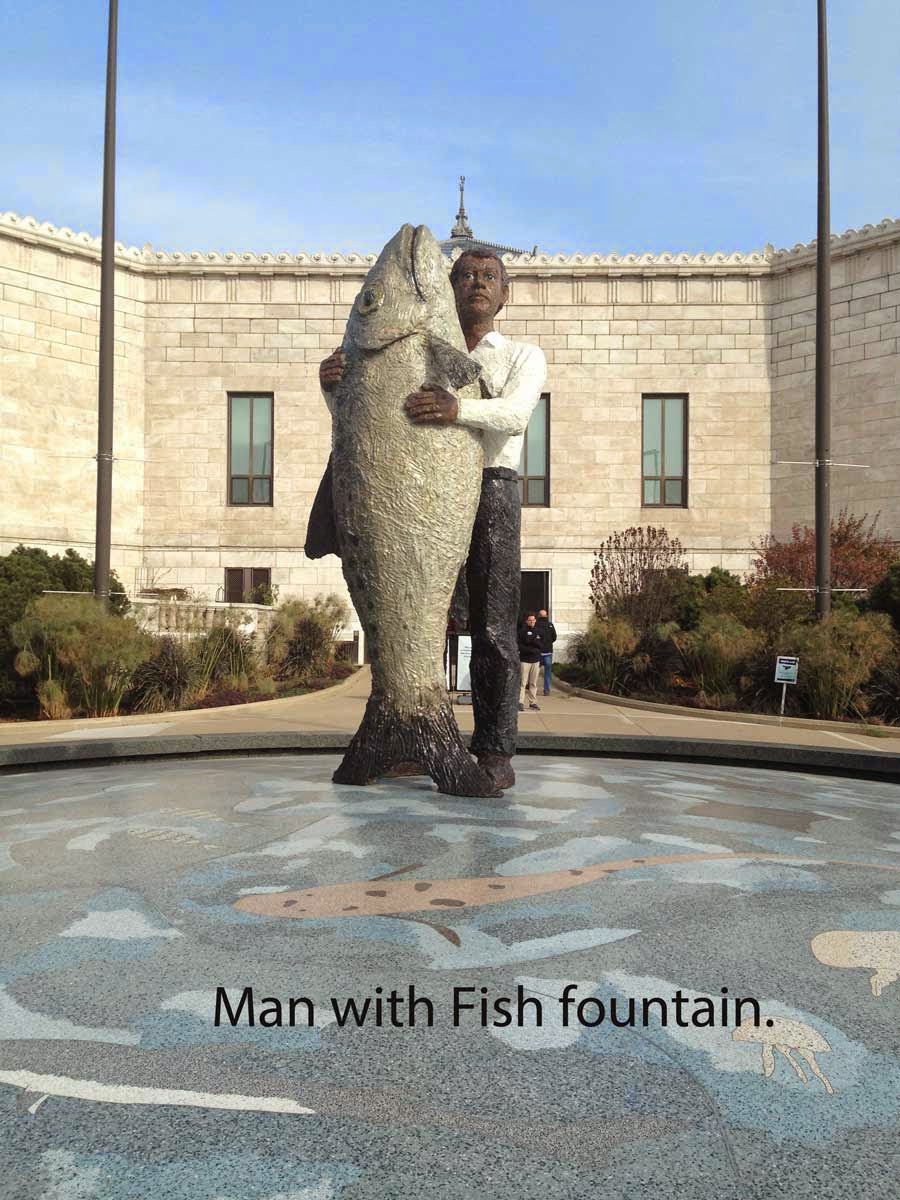
What can a diver do during the dry times? In past blogs, I’ve suggested some dive-themed movies or pool courses, but I have another suggestion: Visit the Shedd Aquarium!

Mike and I and our friends Jerry and Sheryl took the train from Libertyville to Chicago and then caught a taxi to the Shedd. When we arrived, at approximately 11am, a long line of eager fish-lovers stretched down the stairs. The guys gallantly offered to stand in the queue while Sheryl and I sheltered in the slightly less frigid vestibule. In all, the wait was about an hour. You can spare yourself this agony by either arriving early, like when the Shedd opens at 9am, or purchasing your tickets online and going right up to the “will call” booth upon your arrival.

In any case, the wait was well worth it. Before we even got to any aquariums, we were in awe of the architecture. Everywhere we looked, high and low, there were ocean creatures incorporated into the fixtures or trim. It would be fun just to go through and try to find each fish, crab lobster or other marine thing hidden around the building!

As we toured the various areas, we all agreed that it would be great to be able to place a recliner in front of some of the aquariums and just watch the fish swim by. We were lucky to catch the trainers feeding the beluga whales, and the reaction of the huge Asian carp to the divers going into their aquarium to clean. I could walk around the Caribbean Reef display for hours just watching the fish, rays and sharks patrol the 360 degree display. It was a great way to spend a Saturday!


Here are a few of my photos and videos. Obviously, I loved the Jellies exhibit and I am truly grateful to Walgreens for sponsoring it! Next time you are jonesing for the ocean, lake or river, think of the Shedd.


Sunday, November 9, 2014

Sharks

I’m amazed at the number of people who tell me they would never scuba dive because they are afraid of sharks.  These are often the same people who tell me about their trip to Alaska and how wonderful it was to see bears and moose up close. I wonder if they would feel the same if Discovery channel had “Bear Week” or “Moose Week”?

I recall how disappointed I was when we dived a particular spot in Hawaii specifically in the hope that we would see hammerheads and saw none. However, we were rewarded on a later dive when we swam almost the entire time with a dozen or more white tips.  It was fantastic!  The sharks just swam along and not one so much as buzzed us or paid us any mind at all.  My sons, when they were new divers, could not wait to see their first shark!  I would say that most seasoned divers would agree that a shark sighting would be the highlight of any dive.  Sharks are so cool to watch as they slip through the water, so majestic and powerful.  Experience (and science) tells us that sharks are not patrolling the dive sites looking for tasty neoprene wrapped divers to eat!  


To that point, I came across this video on this very topic.  Enjoy!

Sunday, October 12, 2014

I like it!

If you tuned in last week, you read about my least favorite diver behaviors.  I really hate being negative, though, and truly, I have no beef with 95% of divers I come in contact with. In fact there are many characteristics that I find very appealing in my fellow divers.

Courtesy:  Well, duh!  It is so nice to be around divers who take pains to arrive in plenty of time for boat departure.  They ask permission of the captain prior to boarding the dive boat, then board and quietly, assemble their kit and stow the rest of it out of everyone’s way. These divers are sensitive to the needs of others, such as families that want to be seated next to each other, and are willing to move if needed. They do not monopolize the divemaster, nitro analyzer or wash out tank.

Abiders: These divers go with the flow.  They are likely the ones whose air lasts the longest because they take things as they come without getting mad or stressed.  They look for the silver lining in all situations. They don’t grumble about the weather, the vis, the other divers.  Rather, they gravitate to the fun people and quietly avoid the Debbie Downer types.

Fun lovers:  These should not be confused with pranksters or people who take nothing seriously.  Fun lovers arrive at the dive site with a smile on their faces.  They find positives in every situation and their enthusiasm is contagious.  Case in point: Our Appleton contingent who instigated the “I say scuba, you say dive” chant.  While it is admittedly goofy, when you join in on the chant you can’t help but smile.

Team Players: These are those helpful folks who are quick to share their defog or help decipher a new dive camera.  We have been lucky enough to have some Team Players on a dive event with us who actually went so far as to help change a tire! Team players want everyone to have fun and work to make sure it happens. Team players are valuable assets to the dive group who have much to share, but are careful to not to assault people with unsolicited advice. Since they understand that there is no lone ranger on a team, Team Players are not only helpful, but are willing to take help from others.

Environmentalists: These divers know the limitations of their skills.  They do not insist on attempting to hover 2 inches from the coral to get a look at something or take a photo.  They take care to touch neither the flora nor fauna underwater.  They do not smoke and toss their butts into the ocean.  They are careful to police the boat or dive site for stray refuse and take it away where it will not pollute.

Researchers: As someone who plans a lot of dive excursions, it is great to when participants do a little research on their own and offer some suggestions as to what dive sites we should hit, what other activities are available, or where there is a good spot to get pizza. The ability to propose a variety of ideas takes the pressure off of me and likely leads to a more satisfying excursion for everyone involved.


What qualities do you like to see in a fellow diver? Who made a trip particularly fun for you and how did they do it? I would be glad to hear from you!  

Sunday, October 5, 2014

Pet Peeves

Ok, as many of you know, I have been sitting here dry, recovering from my shoulder surgery.  In an effort to pass the time, I have been looking at other scuba blogs and I seem to notice a reoccurring theme: Annoying Diver Behaviors.  I’m sure we all have our “favorites,” and the following are mine.

The Space Hog:  There is not a lot of room on a dive boat, so it is imperative that each diver set up his gear and occupy as little space as possible. Assemble your kit placing your gear bag beneath the bench, I place my fins on the top of the bag for quick access. To further decrease my “footprint” on the boat, I like to attach my mask to my BC shoulder strap and wear my boots and wetsuit (pulled up to my waist.)

The Brief Skipper:  Both the boat briefing and the briefing for the dive site contain important information. You may never need to know some of it, like the location of the emergency oxygen or first aid kit, but if an emergency does occur, do you want to be the idiot standing there with your hands in your pockets, unable to help?  The dive briefing includes not only information about the dive site, but also information on entry and exit procedures.  You may be familiar with the site or the dive operation’s procedures, but others may need to hear the entire briefing, so kindly do not prevent them.  While the divemaster is speaking, shut your mouth and at least appear interested in the information.  This is not only the polite thing to do, but you may even pick up on something you hadn’t heard before.

The Dawdler: As mentioned above, it is best to keep your gear in tidy order for the sake of your boat mates, but this is also a strategy to aid you to quickly don your gear after the dive destination is reached. If all of your gear is in one spot you will not be that knucklehead rummaging through his bag for his flashlight while everyone else is waiting in the water.  Wisely use the travel time to get ready to dive.

Mr. First-in-Line: There’s one on every boat.  This diver needs to be the first to board, often without first asking permission from the captain or crew member.  This diver wants to be the first through swim- throughs, but often is not aware of his fins and screws up the vis for everyone who comes after him. This diver wants the first to get a look at anything the divemaster points out and then chases it a way. This diver departs the boat and monopolizes the wash out tubs with his gear.  Scuba diving is not a race.  When confronted with Mr. First-In-Line, I just steer clear and you can bet that I will not be pointing out anything to him until everyone else has seen it.

The Noise Maker:  One of the things I really like about diving is the silence, but occasionally, it is necessary to get the attention of your buddy.  This is where the quackers, shakers and bangers come in, BUT FOR GOODNESS SAKE, if your buddy does not respond after you have signaled to him, do not continue to make noise!  Swim over to them and tap them on the shoulder.  It is possible that they are busy with something they found on their own, or they already saw the thing you are pointing out, or they just cannot hear you. (This last one is what Mike tells me all the time.)  In any case, respect the silence of the activity and restrain yourself.

Mr. Bad Touch:  I am sad to say that photographers, in their pursuit of the perfect shot, are most often guilty of this crime.  The irony is that while this diver appreciates the beauty of the ocean, he is ruining it by touching the coral or finning on seafans each time he goes in to take a photo.  Divers should not touch anything underwater, and should be especially aware of where their fins are.  One way to really work on this is to dive in areas where the bottom is silty or otherwise easily disturbed.  Navigate for 40 kicks in a straight line, maintaining a depth 1-2 ft. from the bottom.   After 40 kicks, slowly turn around.  If you are faced with a cloudy path back, you know that you have some practicing to do.  Given that the waters around here are getting a bit cold, you may not be crazy about trying this out just now, but a good alternative is to participate in a buoyancy clinic.  As luck would have it, Manta Divers has one scheduled for Jan 10 and 11, 2015.  A course like Peak Performance Buoyancy is one that is worth taking more than once, as there are always little hints that can be picked up through guided practice and coaching from your dive instructor.  We all need to continue to work on our buoyancy.  One other note; if the dive professional on your boat should mention that you need to be a little more careful when diving, take it in stride.  Remember that the health of the reefs directly impact the lives and livelihoods of island peoples. 

The know it all. I always feel sorry for my newly certified divers because, once I set them free, they are immediately assaulted with advice from divers with experience who think they can improve on whatever the new diver’s instructor has taught him.  I would never say that diver education is complete when the certification card in earned, but there is something to be said for letting it all sink in and taking some time to apply what you’ve learned without someone trying to set you on another path.  Your advice may be good, sound and valuable, but is it wanted?  On a recent trip, my son was the youngest diver on the dive boat, and since his parents have a dive shop, most of his gear was fairly new.  One of the “senior” divers assumed that he was a new diver and “kindly” took him under his wing to impart his “vast” diving experience.   I would guess that my son has logged many more dives than this guy, but being the respectful person I raised, he nicely listened and then let it all run off his back, but the guy really came across as a boor and a know-it-all.  It is neighborly to help other divers and give opinions and advice, but only if it is wanted.  Before giving advice, ask if the person is open to hearing it.  If they are, they will be most appreciative.  If they are not, then you have just saved yourself some time and bother.


We’ve all had our weak moments when we have been guilty of some of these missteps, but the main thing is to try to avoid being “that diver.”  Diving is fun, you are on vacation.  Don’t’ race, relax and enjoy.

Sunday, August 31, 2014

Buoyancy

Hello Divers!

Recently, a customer stopped in to inquire about purchasing a 120cuft tank for her husband.  She explained that she and her husband were newly certified divers and that her husband consumed his air so much faster than her.  In their travels to area dive shops, they had been advised that he could even up his air time to match hers by getting a bigger tank. While this definitely a solution, it is not the one I would have suggested.
Poor air consumption can be tracked to poor fitness, physical problems or lack of streamlining.  All of these issues need to be addressed to increase a diver’s air time, but once issues are addressed, before I would suggest a bigger tank, I would challenge the diver to address an even bigger cause of poor air consumption: poor buoyancy.
Good buoyancy leads to better air consumption and more comfortable diving.

We’ve all observed this in action; one diver bicycling along in the water and another flailing his arms like a windmill.  Look for these two to be back on the boat long before the rest of the group.  The quickest exercise for a new diver to do that will give immediate feedback as to their buoyancy is to dive in a horizontal position with arms crossed in front.  If the diver cannot maintain his depth in this position, then some adjustment must be made. 

If they are sinking add air.  Wait a bit for the added air to equilibrate to the surrounding temperature, then reposition: horizontal, arms crossed.  Repeat this process until the diver can maintain the desired depth with minimal movement.  Of course, if the diver is too positive, air should be dumped, but remember that it is possible to dump a small amount of air. After venting a small amount of air, the diver should exhale, then reposition, etc. 

I look at things like getting ankle weights if feet are too buoyant or bigger tanks when air consumption is a problem as masks merely covering the underlying problem. Scuba is like any other skill or hobby.  To be good at it, one needs to practice and continuously learn better technique.  Walter Elliott said, “Perseverance is not a long race: it is many short races one after another.” I think this describes the journey that all of us take to good buoyancy.  We persevere though out fin pivots and hovering exercises in class and then, after earning our certification, we continue on that course to perfection. 


If you want a bit of coaching on your buoyancy, we suggest the Peak Perfomance Buoyancy course, or participation in this winter’s buoyancy clinic.  You may also want to check out this month’s Dive Training magazine and read their pointers for good buoyancy.

Sunday, August 24, 2014

A Shared Story

I like to share my dive experiences, but I also enjoy passing along stories I hear from other divers.  Ken Welch, someone who was a diver back in the day and who has of late gotten back into the sport, (with remarkable zeal, I might add) shared this experience via e-mail:

Dive Training Magazine states on its cover that “A Diver is Always Learning.”  I had a new experience on my last dive.  I had ascended from diving the bow portion of the Milwaukee Car Ferry. I was performing a safety stop at 15 feet.  There was not much current but a NE wind had increased since we had descended. There was a little pitching on the mooring line.  Unfortunately I was a little positively buoyant so I needed to use the mooring line to assist me in maintaining my depth.  My buddy was also hanging on the line 3’ below me.  All of a sudden upon taking a breath, I had a mouthful of water.  I had a mouthpiece in my mouth and could not immediately figure out what was going on.  I reached up with my right hand and found that there was no second stage attached to my mouthpiece.  I took the mouth piece out and switched to my other regulator. Later that evening I inspected the mouthpiece.  Apparently the cable tie that holds the mouthpiece to the second stage had broken and fallen off.  The mouthpiece still had the impression of the cable tie on its surface.  What is interesting is that this regulator was purchased new in January 2014.  Cable ties used for this application have a breaking strength of at least 50 pounds.  Rather than break I think the cable tie failed at the “tooth” that engages the serrations.  The “tooth” failure may have been assisted by my Miflex second-stage hose rubbing against the “tag” sticking out of the “eye” of the cable tie in the choppy water.  I replaced the cable tie with one obtained from Lowes.  I was unable to reproduce the failure.  I also ordered some Thomas and Betts cable ties that conform to a Mil-Spec.  I suspect that this one of those one in a million types of events, but I have added inspection of the cable tie to my pre-dive inspection.  

Regards, Ken

This experience teaches two lessons. First, when things go pear shaped during a dive, calm heads will prevail.  When faced with a malfunctioning regulator, Ken did what all divers are taught in open water class; Stop, Think and Act.  The first order of business was getting some air.  He switched to his alternate air source. With the immediate issue handled, the dive could continue safely.

Second, Ken investigated the issue and made adjustments to his pre-dive plan and improvements to his equipment to prevent this problem from occurring in future dives.


Yes, a good diver is always learning, from magazine articles, dive instructors, personal experiences and the experiences of others.

Monday, August 4, 2014

Lake Michigan Dive

With the short summers we have here in Wisconsin, everyone does their best to make the most of the season.  We at Manta Divers are no exception.

 On Saturday, 6 lucky Team Manta members joined me on two Lake Michigan dives off the catamaran, Mai Tai. I say the participants were lucky, but perhaps quick is a better descriptor.  This dive outing was booked within a week of being posted on our calendar. We left McKinley Marina in Milwaukee at 8am and headed out to the Prinz Willem and the Dredge, two of the lake’s most popular wrecks. The lake was flat as could be, so the 40 minute cruise to the site was particularly enjoyable. I enjoyed sitting on the bow watching the sun climb in the sky, letting the lake breeze blow my hair.

Though the water was exceptionally flat, exceptional underwater visibility was not a guarantee. However, when we got to “The Willie’s” mooring, it looked quite promising.  We all geared up and entered the water, bracing for those first trickles of frigid Lake Michigan to seep into our suits. (That is to say all of us but the drysuit divers!)   After checking that everyone was squared away, we signaled to start the descent. 

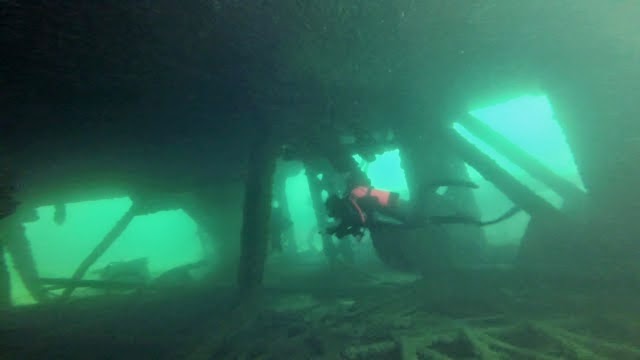
It is imperative in Lake Michigan that divers descend with at least an eye on the mooring line. The thing is that there may be a mild current and even if a diver thinks that he is descending straight down, he may not.  It is exceedingly easy to miss the wreck all together, and not be able to find it at depth.  Therefore, we made our descent along the mooring line and soon were at 70 ft. looking at the stern of the Prinz Willem.  We could see almost to midship from that vantage point, so we all knew we were in for a treat.  We toured around the 258ft ship, now encrusted in mussels and algea. With such great water clarity, divers were better able to get a sense of the majesty of this ill-fated vessel.   As the wetsuiters got cold, and others came to the end of their air, the group ascended and ended the dive.
Photo by Scott Durban

We sat around the charter boat discussing the dive and rehydrating while Captain Rick ferried us to our next site, the Dredge No. 6.  At the Dredge’s mooring, we could see the top of out of the “spuds” for this upside down wreck, portending another clear water dive.  Again we jumped in, checked that everyone was ready and started our descent.  The Dredge is one of my favorite dives, with its inverted position, all the spools and rope hanging underneath, and the huge dredge shovel. On past dives on the Dredge, I had to piece together in my mind what the whole thing looked like from small 10ft.snapshots, but on Saturday, we could almost see it in its entirety. So cool!


We will definitely make some dates to do this again next year, but believe me when I say to get your money in ASAP once the dates are announced, or you will be missing out again!